
Rebeca Raijman Adriana Kemp
Migrants and Workers: The Political Economy of Labor Migration in Israel Book
Van Leer Institute and Hakibbutz Hameuchad Publishing House, 2008.
@book{nokeyn,

title = {Migrants and Workers: The Political Economy of Labor Migration in Israel},

author = {Rebeca Raijman Adriana Kemp},

url = {http://people.socsci.tau.ac.il/mu/adrianakemp/files/2017/04/92_PDF.pdf},

year  = {2008},

date = {2008-01-01},

urldate = {2008-01-01},

journal = {(2008). Migrants and workers: The political economy of labor migration in Israel. Jerusalem: Van Leer Institute and Hakibbutz Hameuchad Publishing House.},

publisher = { Van Leer Institute and Hakibbutz Hameuchad Publishing House},

keywords = {},

pubstate = {published},

tppubtype = {book}

}
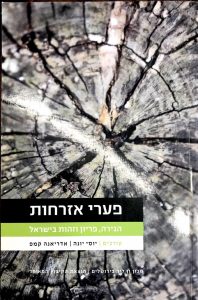
Citizenship Gaps: Migration, Fertility and Identity in Israel Book
Hakibbutz Hameuchad Publishing House, 2008.
@book{nokeyo,

title = {Citizenship Gaps: Migration, Fertility and Identity in Israel},

url = {http://people.socsci.tau.ac.il/mu/adrianakemp/files/2017/05/95_PDF.pdf},

year  = {2008},

date = {2008-01-01},

urldate = {2008-01-01},

publisher = {Hakibbutz Hameuchad Publishing House},

abstract = {This set of papers deals with social and political trends that create gaps between Israeli citizens and practices with which various groups attempt to contend with these gaps. The book focuses mainly on the nation-state’s mechanisms of exclusion and on groups that are prevented from belonging or are shunted to its political, economic, and cultural margins. Nevertheless, it does not ignore the role of mechanisms that make possible the inclusion of individuals and groups in the society, because the nation-state’s mechanisms of exclusion and inclusion are but two sides of the same coin.The analysis of these complex mechanisms is carried out in light of the broad, worldwide discussion of the topic, as reflected in the relevant literature, and through an examination of the political, economic, cultural, and intellectual developments that characterize the global era. The papers in the book attempt to examine, inter alia, how the accelerated flow of capital, goods, information, and people—which processes of globalization entail—creates a growing disparity between the political and legal framework that defines civil rights, that is, the nation-state, and the complex sociological reality that encourages deep structural inequality in the way in which those rights are allocated.' author = Yonah Yossi, Kemp Adriana},

keywords = {},

pubstate = {published},

tppubtype = {book}

}

Newman David Ram Uri Kemp Adriana
Israelis in Conflict: Hegemonies, Identities and Challenges Book
Sussex Academic Press, 2004.
@book{nokeyy,

title = {Israelis in Conflict: Hegemonies, Identities and Challenges},

author = {Newman David Ram Uri Kemp Adriana},

url = {https://www.amazon.com/Israelis-Conflict-Hegemonies-Identities-Challenges/dp/1845196740},

year  = {2004},

date = {2004-01-01},

urldate = {2004-01-01},

publisher = {Sussex Academic Press},

abstract = {Globalisation and increased cultural heterogeneity have had a major impact on states whose identity has been defined in terms of a single, often socially constructed, allegiance to the state and a single hegemonic ideology. Nowhere are changing notions of identity more prevalent than in Israel, a country whose dominant (Western-Jewish) society has been subject to understanding their past and present in terms of a single ideology of state formation – Zionism. This book challenges some of the traditional analytical paradigms prevalent in Israeli social science for the past fifty years.},

keywords = {},

pubstate = {published},

tppubtype = {book}

}
A. Kemp Y. Feniger (Ed.)
Paradoxes of control: Incorporating precarious migrants in Tel-Aviv in times of restrictive migration policies Book Chapter
In: Feniger, A. Kemp Y. (Ed.): The Routledge Handbook of the Contemporary Israel, Routledge (forthcoming), 2020.
@inbook{nokey_37,

title = {Paradoxes of control: Incorporating precarious migrants in Tel-Aviv in times of restrictive migration policies},

editor = {A. Kemp Y. Feniger},

year  = {2020},

date = {2020-01-01},

booktitle = {The Routledge Handbook of the Contemporary Israel, Routledge (forthcoming)},

keywords = {},

pubstate = {published},

tppubtype = {inbook}

}
P. Scholten T. Caponio A. Kemp; R. Zapata-Barrero (Eds.) (Ed.)
Urban citizenship in times of emergency: The impact of national control policies on the incorporation of precarious migrants in Tel Aviv/Jaffa. Book Chapter
In: Kemp, P. Scholten T. Caponio A.; (Eds.), R. Zapata-Barrero (Ed.): The Routledge Handbook of the Governance of Migration and Diversity in Cities. Routledge, p 329-342., 2019.
@inbook{nokey_38,

title = {Urban citizenship in times of emergency: The impact of national control policies on the incorporation of precarious migrants in Tel Aviv/Jaffa.},

editor = {P. Scholten T. Caponio A. Kemp and R. Zapata-Barrero (Eds.)},

year  = {2019},

date = {2019-01-01},

booktitle = {The Routledge Handbook of the Governance of Migration and Diversity in Cities. Routledge, p 329-342.},

keywords = {},

pubstate = {published},

tppubtype = {inbook}

}
A. Kemp; R. Raijman. Mark Overmyer-Velázquez; Enrique Sepulveda (Eds.) (Ed.)
The making and unmaking of a community of Latino labor migrants in Israel Book Chapter
In: Kemp, A.; Overmyer-Velázquez, R. Raijman. Mark; (Eds.), Enrique Sepulveda (Ed.): Global Latin(o) Americanos: Transoceanic Diasporas and Regional Migrations. New York-Oxford: Oxford University Press, 2018 (chapter 8), 2018.
@inbook{nokey_39,

title = {The making and unmaking of a community of Latino labor migrants in Israel},

editor = {A. Kemp and R. Raijman. Mark Overmyer-Velázquez and Enrique Sepulveda (Eds.)},

url = {http://people.socsci.tau.ac.il/mu/adrianakemp/files/2020/06/The-making-and-unmaking-of-a-community-of-Latino-labor-migrants-in-Israel.pdf},

year  = {2018},

date = {2018-01-01},

booktitle = {Global Latin(o) Americanos: Transoceanic Diasporas and Regional Migrations. New York-Oxford: Oxford University Press, 2018 (chapter 8)},

keywords = {},

pubstate = {published},

tppubtype = {inbook}

}
A. Kemp. G. Melville; C. Ruta (Eds.) (Ed.)
Community, Illegality and Belonging: Undocumented Migrant Workers and Anti-deportation Campaigns in Israel”. Book Chapter
In: Melville, A. Kemp. G.; (Eds.), C. Ruta (Ed.): Potency of the Common: Intercultural Perspectives about Community and Individuality. Oldenbourg: DeGruyter, pp. 281-302,, 2016.
@inbook{nokey_42,

title = {Community, Illegality and Belonging: Undocumented Migrant Workers and Anti-deportation Campaigns in Israel”.},

editor = {A. Kemp. G. Melville and C. Ruta (Eds.)},

year  = {2016},

date = {2016-01-01},

booktitle = {Potency of the Common: Intercultural Perspectives about Community and Individuality. Oldenbourg: DeGruyter, pp. 281-302,},

keywords = {},

pubstate = {published},

tppubtype = {inbook}

}
R. Raijman; A. Kemp (Ed.)
Labor Migration in Israel: The Creation of a Non-free Workforce Book Chapter
In: Raijman, R.; Kemp, A. (Ed.): Proto-Sociology 27, pp. 177-195, 2011, 2011.
@inbook{nokey_40,

title = {Labor Migration in Israel: The Creation of a Non-free Workforce},

editor = {R. Raijman and A. Kemp},

url = {http://people.socsci.tau.ac.il/mu/adrianakemp/files/2020/06/Labor-Migration-in-Israel-The-Creation-of-a-Non-free-Workforce.pdf},

year  = {2011},

date = {2011-01-01},

booktitle = {Proto-Sociology 27, pp. 177-195, 2011},

keywords = {},

pubstate = {published},

tppubtype = {inbook}

}
N. Berkovitch; Tamara Harvey Paula Ruth Gilbert A. Kemp. Debra Bergoffen; Connie L. McNeely (Eds.) (Ed.)
Economic Empowerment of Women' as a Global Project: Economic Rights in the Neo-Liberal Era Book Chapter
In: Berkovitch, N.; Bergoffen, Tamara Harvey Paula Ruth Gilbert A. Kemp. Debra; (Eds.), Connie L. McNeely (Ed.): Confronting Global Gender Justice: Women's Lives, Human Rights. Oxford, UK: Routledge, pp. 158-179, 2010., 2010.
@inbook{nokey_41,

title = {Economic Empowerment of Women' as a Global Project: Economic Rights in the Neo-Liberal Era},

editor = {N. Berkovitch and Tamara Harvey Paula Ruth Gilbert A. Kemp. Debra Bergoffen and Connie L. McNeely (Eds.)},

url = {http://people.socsci.tau.ac.il/mu/adrianakemp/files/2020/06/Economic-Empowerment-of-Women-as-a-Global-Project-Economic-Rights-in-the-Neo-Liberal-Era.pdf},

year  = {2010},

date = {2010-01-01},

booktitle = {Confronting Global Gender Justice: Women's Lives, Human Rights. Oxford, UK: Routledge, pp. 158-179, 2010.},

keywords = {},

pubstate = {published},

tppubtype = {inbook}

}
A. Kemp; F. J. Moreno Fuentes (Ed.)
Between border policies and welfare control. A comparative analysis of immigration policy in Spain and Israel Book Chapter
In: Kemp, A.; Fuentes, F. J. Moreno (Ed.): IEMed and The Centre for the Study of European Politics and Society Publications (2010), 2010.
@inbook{nokey_43,

title = {Between border policies and welfare control. A comparative analysis of immigration policy in Spain and Israel},

editor = {A. Kemp and F. J. Moreno Fuentes},

url = {http://people.socsci.tau.ac.il/mu/adrianakemp/files/2020/06/Between-border-policies-and-welfare-control.-A-comparative-analysis-of-immigration-policy-in-Spain-and-Israel.pdf},

year  = {2010},

date = {2010-01-01},

booktitle = {IEMed and The Centre for the Study of European Politics and Society Publications (2010)},

keywords = {},

pubstate = {published},

tppubtype = {inbook}

}
H. Herzog; ) A. Kemp in I. Dublon-Knebel (Ed (Ed.)
Do We Have a Home? The "Sense of Home" in the Narratives of Jewish Women Survivors of Ravensbruוck Book Chapter
In: Herzog, H.;in I. Dublon-Knebel (Ed, ) A. Kemp (Ed.): A Holocaust Crossroads: Jewish Women in Ravensbruck, London: Valentine Mitchell, pp. 176-204, 2010.
@inbook{nokey_44,

title = {Do We Have a Home? The "Sense of Home" in the Narratives of Jewish Women Survivors of Ravensbruוck},

editor = {H. Herzog and ) A. Kemp in I. Dublon-Knebel (Ed},

url = {http://people.socsci.tau.ac.il/mu/adrianakemp/files/2020/06/Do-We-Have-a-Home-The-Sense-of-Home-in-the-Narratives-of-Jewish-Women-Survivors-of-Ravensbruוck..pdf},

year  = {2010},

date = {2010-01-01},

booktitle = {A Holocaust Crossroads: Jewish Women in Ravensbruck, London: Valentine Mitchell, pp. 176-204},

keywords = {},

pubstate = {published},

tppubtype = {inbook}

}
R. Raijman; N. Mayadas A. Kemp. U. Segal; D. Elliott (Eds.) (Ed.)
The New Immigration to Israel: Becoming a De-Facto Immigration State in the 1990s Book Chapter
In: Raijman, R.; Segal, N. Mayadas A. Kemp. U.; (Eds.), D. Elliott (Ed.): Immigration Worldwide, Cambridge: Oxford University Press, pp. 227-243, 2009., 2009.
@inbook{nokey_45,

title = {The New Immigration to Israel: Becoming a De-Facto Immigration State in the 1990s},

editor = {R. Raijman and N. Mayadas A. Kemp. U. Segal and D. Elliott (Eds.)},

url = {http://people.socsci.tau.ac.il/mu/adrianakemp/files/2020/06/The-New-Immigration-to-Israel-Becoming-a-De-Facto-Immigration-State-in-the-1990s.pdf},

year  = {2009},

date = {2009-01-01},

booktitle = {Immigration Worldwide, Cambridge: Oxford University Press, pp. 227-243, 2009.},

keywords = {},

pubstate = {published},

tppubtype = {inbook}

}
S. Goldin; A. Kemp. Y. Shenhav; Y. Yonah (Eds.) (Ed.)
Foreign and Fertile: The biopolitics of labor migration, body and gender Book Chapter
In: Goldin, S.; Shenhav, A. Kemp. Y.; (Eds.), Y. Yonah (Ed.): Racism in Israel, Hakibbutz Hameuchad and Van Leer Jerusalem Institute, pp. 258-286. 2008 (Hebrew), 2008.
@inbook{nokey_46,

title = {Foreign and Fertile: The biopolitics of labor migration, body and gender},

editor = {S. Goldin and A. Kemp. Y. Shenhav and Y. Yonah (Eds.)},

year  = {2008},

date = {2008-01-01},

booktitle = {Racism in Israel, Hakibbutz Hameuchad and Van Leer Jerusalem Institute, pp. 258-286. 2008 (Hebrew)},

keywords = {},

pubstate = {published},

tppubtype = {inbook}

}
Y. Yonah; A. Kemp (Eds.) (Ed.)
Migration, Fertility and Identity in Israel: Towards a new age? Book Chapter
In: Yonah, Y.; (Eds.), A. Kemp (Ed.): Citizenship Gaps: Migration, Fertility and Identity in Israel, Hakibbutz Hameuchad and Van Leer Jerusalem Institute, pp. 9-36, 2008 (Hebrew), 2008.
@inbook{nokey_47,

title = {Migration, Fertility and Identity in Israel: Towards a new age?},

editor = {Y. Yonah and A. Kemp (Eds.)},

url = {http://people.socsci.tau.ac.il/mu/adrianakemp/files/2020/06/Migration-Fertility-and-Identity-in-Israel-Towards-a-new-age.pdf},

year  = {2008},

date = {2008-01-01},

booktitle = {Citizenship Gaps: Migration, Fertility and Identity in Israel, Hakibbutz Hameuchad and Van Leer Jerusalem Institute, pp. 9-36, 2008 (Hebrew)},

keywords = {},

pubstate = {published},

tppubtype = {inbook}

}
R. Raijman; A. Kemp. Sarah S. Willen (Ed.) (Ed.)
Labor Migration, Managing the Ethno-national Conflict, and Client Politics in Israel. Book Chapter
In: Raijman, R.; (Ed.), A. Kemp. Sarah S. Willen (Ed.): Transnational Migration to Israel in Global Comparative Context, Lanham: MD Lexington, pp. 31-50, 2007., 2007.
@inbook{nokey_48,

title = {Labor Migration, Managing the Ethno-national Conflict, and Client Politics in Israel.},

editor = {R. Raijman and A. Kemp. Sarah S. Willen (Ed.)},

year  = {2007},

date = {2007-01-01},

booktitle = {Transnational Migration to Israel in Global Comparative Context, Lanham: MD Lexington, pp. 31-50, 2007.},

keywords = {},

pubstate = {published},

tppubtype = {inbook}

}
A. Kemp; R. Raijman. U. Ram; N. Berkovitch (Eds.) (Ed.)
Labor Migration Book Chapter
In: Kemp, A.; Ram, R. Raijman. U.; (Eds.), N. Berkovitch (Ed.): In/Equality, Ben Gurion University Press pp. 125-132, 2007 (Hebrew), 2007.
@inbook{nokey_49,

title = {Labor Migration},

editor = {A. Kemp and R. Raijman. U. Ram and N. Berkovitch (Eds.)},

year  = {2007},

date = {2007-01-01},

booktitle = {In/Equality, Ben Gurion University Press pp. 125-132, 2007 (Hebrew)},

keywords = {},

pubstate = {published},

tppubtype = {inbook}

}
A. Kemp. I. Ness (Ed.)
Zionism, colonization, settlement and occupation Encyclopedia Entry
In: Ness, A. Kemp. I. (Ed.): The Encyclopedia of Global Human Migration, Wiley-Blackwell 201), .
@encycl{nokey_57,

title = {Zionism, colonization, settlement and occupation},

editor = {A. Kemp. I. Ness },

url = {https://people.socsci.tau.ac.il/mu/adrianakemp/files/2020/06/Zionism-colonization-settlement-and-occupation.pdf},

year  = {2012},

date = {2012-01-01},

urldate = {2012-01-01},

booktitle = {The Encyclopedia of Global Human Migration, Wiley-Blackwell 201)},

keywords = {},

pubstate = {published},

tppubtype = {encycl}

}
A. R. Raijman Kemp; R. Geffen
Who drives migration discourse and in what direction: Claims-making and political mobilization analyses of labor migration in Israel Journal Article
IF: 2.297 Ranking: 2/18 (Ethnic Studies); 4/29 (Demography) Q1, Journal of Ethnic and Migration Studies, 2020.
@article{nokeyz,

title = {Who drives migration discourse and in what direction: Claims-making and political mobilization analyses of labor migration in Israel},

author = {A. R. Raijman Kemp and R. Geffen},

url = {https://www.tandfonline.com/eprint/NDCHJNNEUIBA42KMNKAY/full?target=10.1080/1369183X.2020.1759403

http://people.socsci.tau.ac.il/mu/adrianakemp/files/2020/06/Who-drives-migration-discourse-and-in-what-direction-claims-making-and-political-mobilisation-analyses-of-labor-migration-in-Israel.pdf

},

year  = {2020},

date = {2020-01-01},

urldate = {2020-01-01},

journal = {IF: 2.297 Ranking: 2/18 (Ethnic Studies); 4/29 (Demography) Q1, Journal of Ethnic and Migration Studies, 2020},

abstract = {As labor migration policies increasingly operate at the crossroads of neoliberal political economies, nativist nationalisms and assertive human rights activism, serious debates have emerged about whose logic is setting the discourse on migration issues, in what direction and with what justifications. Yet, while the actors driving the public discourse have been a central concern for scholars interested in the institutional transformation of migration politics, research on the migration discourse and claims-making has largely overlooked them. Drawing on an original data set of 1,300 collective claims on labor migration reported in Israeli print media during 2000–2012, we investigate two aspects of claims-making: the public claims mobilised by state and non-state actors, and the discursive opportunity structure in which they evolve. Our analysis of the claims mobilised by actors situated in different institutional positions and their political framings regarding the control and integration of legal and undocumented labor migrants seeks to fill the gap in the migration discourse literature. We also contribute to recent claims-making and political mobilisation analyses by bringing the actor-driven logic to bear on major debates regarding the institutional politics of migration and examining them empirically in relation to each other.},

keywords = {},

pubstate = {published},

tppubtype = {article}

}
A. Kemp; N. Berkovitch
Uneasy passages between neoliberalism and feminism: Social inclusion and financialisation in Israel's empowerment microfinance Journal Article
IF 2.273 Rank: 4/44 (Women Studies) Q1, Gender, Work & Organization.
@article{nokey_27,

title = {Uneasy passages between neoliberalism and feminism: Social inclusion and financialisation in Israel's empowerment microfinance},

author = {A. Kemp and N. Berkovitch},

url = {https://doi.org/10.1111/gwao.12400

http://people.socsci.tau.ac.il/mu/adrianakemp/files/2020/06/Uneasy-passages-between-neoliberalism-and-feminism.pdf

},

year  = {2020},

date = {2020-01-01},

urldate = {2020-01-01},

journal = {IF 2.273 Rank: 4/44 (Women Studies) Q1, Gender, Work & Organization},

abstract = {This article focuses on feminist non‐governmental organizations advocating for economic empowerment of women (EEW) through microfinance, using Israel as a case study. Through fieldwork, interviews and documents, we investigate the institutional practices, cultural discourses and struggles that EEWs develop in order to expose the particular ways in which feminist organizations interact with the world of finance and state institutions. Our analysis points to the complex power dynamics of mediation, suggesting that there are ‘uneasy passages’ between neoliberalism and feminism, ones that help re‐signify the meaning of financial discourses while re‐politicizing women's social and economic exclusions. Simultaneously, however, this relation induces a series of compromises, whereby EEWs adopt neoliberal modes of governance. Rejecting the notion that contemporary feminism has simply been co‐opted by neoliberalism or the perception of EEW microfinance as a mere expansion of neoliberal rationalities, we reveal new sites and ways in which feminism both colludes and collides with neoliberalism.},

keywords = {},

pubstate = {published},

tppubtype = {article}

}
T. Margalit; A. Kemp
Stratified and Defensive Democracy: A Study of Israeli Planning Hearings Journal Article
IF 3.272 Rank: 7/ 40 (Urban Studies) Q1,Urban Studies.
@article{nokeyw,

title = {Stratified and Defensive Democracy: A Study of Israeli Planning Hearings},

author = {T. Margalit and A. Kemp},

url = {https://journals.sagepub.com/doi/abs/10.1177/0042098018810321},

year  = {2019},

date = {2019-01-01},

journal = {IF 3.272 Rank: 7/ 40 (Urban Studies) Q1,Urban Studies},

abstract = {This article contributes to the debate on inclusion and democracy in planning by comparing the answers given by five Israeli district committees to objections to planning proposals in nine cities, and by analysing their discourse in terms of socio-spatial inequality. We investigate how the committees’ answers to various professionals and civil actors, and how the type and degree of effort they invest in justifying their decisions, reflect their views of existing social divisions. We consider current theses on compromises to planning democracy. First, we follow urban regime theorists and compare the planners’ answers to objections submitted by their professional and development peers, and by ordinary people. Second, we follow theories on identity and class-related biases, and compare the committees’ answers to objectors along Israeli socio-spatial and ethnic disparities. Third, we trace planners’ post-political methods to simultaneously protect and legitimate their decisions. We demonstrate evidence of a combination of a positive bias towards the most powerful actors, a negative bias towards the least powerful ones, and many less obvious and neutral answers to those in the middle. We argue that with this array of answers and justifications, Israeli committees preserve a superficial display of inclusion and legitimation.},

keywords = {},

pubstate = {published},

tppubtype = {article}

}
T. Margalit; A. Kemp
The uneven geographies of post-political planning: Objections to urban regeneration projects in peripheral and central Israeli cities Journal Article
IF 2.459 Rank: 28/83 (Geography) 5 Year IF 3.146 Rank: 22/83 JCR Q1 38/699 (Geography, Planning and Development) SJR Q1, Environment and Planning A: Economy and Space 51 (4) 931-949.
@article{nokeyx,

title = {The uneven geographies of post-political planning: Objections to urban regeneration projects in peripheral and central Israeli cities},

author = {T. Margalit and A. Kemp},

url = {https://journals.sagepub.com/doi/10.1177/0308518X18819003},

year  = {2019},

date = {2019-01-01},

journal = {IF 2.459 Rank: 28/83 (Geography) 5 Year IF 3.146 Rank: 22/83 JCR Q1 38/699 (Geography, Planning and Development) SJR Q1, Environment and Planning A: Economy and Space 51 (4) 931-949},

abstract = {This article probes the Israeli ‘Clearance and Construction’ urban regeneration programme, which encourages apartment owners nationwide to turn their old dwellings into new tower-clusters. By comparing distinct planning communications on such projects, we aim to contribute a class-related perspective to the debate on post-politics in planning. Planning literature addresses the neutralizing effects of the neoliberal ethos on urban regeneration, highlighting the techniques through which planners dismiss community needs, use values and local voices. We respond to scholars calling for more nuanced perspectives by analysing a dataset of objection hearings in different cities, tracing how planners present their decisions and advance projects, and how different social groups accept and/or reject planners’ rationale. Our findings point to two main outcomes: first, we show that most participants accept the entrepreneurial rationale but their discourse often mixes acceptance with dissent; second, we show that such mixed discourses vary across locations and reflect socio-spatial distinctions. The more affluent participants objected more and highlighted use values and the public interest, yet their discourse largely echoed planners’ discourses. Conversely, the poorer objectors, who focused on exchange values, disrupted the consensual planning order by highlighting their own hopes and personal struggles. Who, then, were more submissive to neoliberal ethos? These results, we argue, call for a nuanced analysis of current planning relations. We argue that such analysis should specifically look at synchronization between consensual planning and co-optation, dissent and socio-spatial deviation.},

keywords = {},

pubstate = {published},

tppubtype = {article}

}
N. Krausz-Lahav; A. Kemp
Elites without elitism: Boundary work and the Israeli philanthropy in a changing field of power Journal Article
IF 2.789 Rank: 17/148 (Sociology) Q1, Social Problems.
@article{nokey_28,

title = {Elites without elitism: Boundary work and the Israeli philanthropy in a changing field of power},

author = {N. Krausz-Lahav and A. Kemp},

url = {https://doi.org/10.1093/socpro/spz015

http://people.socsci.tau.ac.il/mu/adrianakemp/files/2020/06/Elites-without-elitism.pdf},

year  = {2019},

date = {2019-01-01},

urldate = {2019-01-01},

journal = {IF 2.789 Rank: 17/148 (Sociology) Q1, Social Problems},

abstract = {The crisis of neoliberalism and the upsurge of populist politics have renewed interest in how contemporary economic elites justify their privileged position, trying to be “moral” and “rich” in an era of increasing inequality and an anti-elite climate. We addressed this question through an ethnographic analysis of the socio-cultural life of the heirs of the Israeli economic elite and of the boundary-making processes that philanthropy allows them as they face internal and external challenges. Adopting analytical tools from a cultural process approach to inequality and a contextual approach to elite distinction, we suggest that the heirs generate distinct social and symbolic position within a changing field of power by presenting themselves as an “elite without elitism.” This is accomplished through a mutually reinforcing interplay between intra-elite distinctions and “inter-class inconspicuous distinction.” We contribute to the current analysis of elite reproduction “beyond Bourdieu” first by pointing at the (re)production of power and difference within the elite, and second by showing that where distinctions are drawn, matters.},

keywords = {},

pubstate = {published},

tppubtype = {article}

}
A.Kemp
Resisting Neoliberal Skylines: Social Mobilizations and Urban Development in Tel Aviv Journal Article
International Development Policy Revue internationale de politique de développement, Vol 8, (pp. 164-188). Q1 in Development Studies and in European Studies.
@article{nokeyu,

title = {Resisting Neoliberal Skylines: Social Mobilizations and Urban Development in Tel Aviv},

author = {A.Kemp},

url = {https://journals.openedition.org/poldev/2311},

year  = {2017},

date = {2017-01-01},

journal = {International Development Policy Revue internationale de politique de développement, Vol 8, (pp. 164-188). Q1 in Development Studies and in European Studies},

abstract = {The article examines recent social mobilisations against the planning and building of towers in Tel Aviv to address ongoing debates over the impact of social activism on the neoliberalization of urban development in times of neoliberalism’s “legitimation crisis.” Contrary to binary views of “neoliberalism vs. resistance” prevalent in scholarly debates, we look into the uneven ways in which urban mobilisations are conditioned by local configurations of neo-liberalisation, and how, in their turn, they affect neoliberal practices as they oscillate between resistance and integration. Based on empirical analysis, we argue that while recent mobilisations introduced novel claims and tactics against the institutional methods and decisions that produce urban space, and succeeded in politicizing towers as the flagship of neoliberal urban development, their actions have been re- inserted in the deepening neo-liberalisation of the city. Our findings raise broader insights about the ways in which neo-liberalisation processes sit inside society and not above it, as they shape the actors concerned, their positions, and their visions of development.},

keywords = {},

pubstate = {published},

tppubtype = {article}

}
Adriana Kemp Raijman Rebeca
The Institutionalization of Labor Migration in Israel Journal Article
Arbor 192 (777), 2016 (pp.289).
@article{nokeyf,

title = {The Institutionalization of Labor Migration in Israel},

author = {Adriana Kemp Raijman Rebeca},

url = {http://people.socsci.tau.ac.il/mu/adrianakemp/files/2017/03/The-institutionalization-of-labor-migration-in-Israel-arbor2016.pdf},

year  = {2016},

date = {2016-01-01},

journal = {Arbor 192 (777), 2016 (pp.289)},

abstract = {In this paper we shed light into the process of institutionalization of labor migration in Israel. Specifically, we show the ways by which state regulations created a fertile ground for the creation of a precarious and captive labor force of non-citizens in the Israeli labor market. We focus on the following four main dimensions: (1) the policy of quotas, work permits, and subsidies; (2) the binding system which regulates employment relations; (3) the creation of an infrastructure for manpower agencies that over time became the main stakeholder in the institutionalization of labor migration; and (4) the creation of a complementary mechanism for the “discipline” and control of workers in the form of the deportation policy},

keywords = {},

pubstate = {published},

tppubtype = {article}

}
Nelly Kfir Adriana Kemp
Wanted Workers but Unwanted Mothers: Mobilizing Moral Claims on Migrant Care Workers’ Families in Israel Journal Article
Social Problems, 2016. IF: 1.729, 5 Year IF: 2.669; Rank:15/142 (Sociology) Q1 Soc Probl (2016) 63 (3): 373-394.
@article{nokeyk,

title = {Wanted Workers but Unwanted Mothers: Mobilizing Moral Claims on Migrant Care Workers’ Families in Israel},

author = {Nelly Kfir Adriana Kemp},

url = {https://academic.oup.com/socpro/article/63/3/373/2468875/Wanted-Workers-but-Unwanted-Mothers-Mobilizing

http://people.socsci.tau.ac.il/mu/adrianakemp/files/2017/04/Kemp-and-Kfir-2014.155R2.pdf},

year  = {2016},

date = {2016-01-01},

urldate = {2016-01-01},

journal = {Social Problems, 2016. IF: 1.729, 5 Year IF: 2.669; Rank:15/142 (Sociology) Q1 Soc Probl (2016) 63 (3): 373-394},

abstract = {Literature on global care work deals with biopolitical tensions between care markets and exclusionary migration regimes leading to the formation of transnational families. Nevertheless, it disregards how these tensions produce “illegal” families within countries of destination, catalyzing the mobilization of moral claims over their recognition in the local civil society. To fill this lacuna, this article looks at the interface between migration policies controlling the reproductive lives of migrant care workers and the mobilization of ethical claims and moral constructions of care from below (i.e., movements and organizations advocating for care workers). Based on fieldwork in Israeli advocacy NGOs and the 2009 anti-deportation campaign, we suggest that the socio legal position of migrant care workers’ families in destination countries is shaped not only by state policies and market dynamics but also by the types of social mobilizations, ethical evaluations, and pragmatic strategizing they spur in civil society. Findings show that while anti-deportation networks and NGO’s advocacy succeeded in achieving public recognition of the reproductive needs and lives of care workers, their forms of moral reasoning and strategizing reinforced definitions of care workers as primarily workers and of their children as humanitarian exceptions to the non-immigration regime. We conclude by arguing that the transformative power of the politics of ethical claims from below in stringent ethnonational regimes like the Israeli may be contingent on its not disrupting the tensions between wanted workers and unwanted families but rendering them manageable. As such, civil society’s social and moral agency broadens the range of actors and dynamics shaping the globalization of care as well as its contradictions.},

keywords = {},

pubstate = {published},

tppubtype = {article}

}
Nelly Kfir A. Kemp
Making Migrants’ Rights in ‘Non-immigration’ Regimes: Ethnography of Labor Migrants’ Rights Activism in Israel and Singapore Journal Article
Vol. 50(1), (pp. 82-116). IF: 1.310; 5 Year IF: 1.74, Rank: 31/138 (Sociology) Q1, Appears also in 2019 Recap of Recent Popular Articles: “See What Your Colleagues are Reading in LSR.
@article{nokeyv,

title = {Making Migrants’ Rights in ‘Non-immigration’ Regimes: Ethnography of Labor Migrants’ Rights Activism in Israel and Singapore},

author = {Nelly Kfir A. Kemp},

url = {https://onlinelibrary.wiley.com/doi/abs/10.1111/lasr.12179},

year  = {2016},

date = {2016-01-01},

journal = {Vol. 50(1), (pp. 82-116). IF: 1.310; 5 Year IF: 1.74, Rank: 31/138 (Sociology) Q1, Appears also in 2019 Recap of Recent Popular Articles: “See What Your Colleagues are Reading in LSR},

abstract = {How are the rights of migrant workers mobilized in non‐immigration regimes? Drawing on an ethnography of human rights NGOs in Israel and Singapore, two countries that share similar ethnic policies but differ in their political regime, this study contributes to scholarship on migrants’ rights mobilization by expanding cross‐national analysis beyond the United States and West Europe and diverting its focus from legal institutions to the places where rights are produced. Findings show that differences in the political regime influence the channels for mobilizing claims but not the cultural politics of resonance that NGOs use when dealing with the tensions between restrictive ethnic policies and the expansion of labor migration. While restraints in authoritarian Singapore operate mainly outside the activists’ circle, in the Israeli ethno‐democracy they operate through self‐disciplining processes that neutralize their potential challenge to hegemonic understandings of citizenship. Paradoxically, success in advancing rights for migrants through resonance often results in reinforcing the non‐immigration regime.},

keywords = {},

pubstate = {published},

tppubtype = {article}

}
Galia Rattner Henrik Lebuhn Adriana Kemp
Between Neoliberal Governance and the Right to the City: Participatory politics in Berlin and Tel Aviv Journal Article
International Journal of Urban and Regional Research 39(4), 2015 (pp. 704-725) IF: 1.625; 5YIF: 1.8; Rank: 20/137 (Sociology) Q1; 7/39 (Urban Studies) Q1; 17/76 (Geography) Q1.
@article{nokeyg,

title = {Between Neoliberal Governance and the Right to the City: Participatory politics in Berlin and Tel Aviv},

author = {Galia Rattner Henrik Lebuhn Adriana Kemp},

url = {http://onlinelibrary.wiley.com/doi/10.1111/1468-2427.12262/abstract

http://people.socsci.tau.ac.il/mu/adrianakemp/files/2017/03/Kemp_et_al-2015-International_Journal_of_Urban_and_Regional.pdf},

year  = {2015},

date = {2015-01-01},

urldate = {2015-01-01},

journal = {International Journal of Urban and Regional Research 39(4), 2015 (pp. 704-725) IF: 1.625; 5YIF: 1.8; Rank: 20/137 (Sociology) Q1; 7/39 (Urban Studies) Q1; 17/76 (Geography) Q1},

abstract = {Based on a comparison of Berlin and Tel Aviv, this article investigates the ways in which ensembles of participatory instruments mediate between neoliberal urban regimes and political agency shaping differentially the meaning of participation and the types of claims that can be advanced. The article gives an overview of the recent history of both cities through the lens of participatory politics. Two in-depth case studies further examine the relationship between participatory politics and claim making in each setting: the recent conflict over a social center in the district of Friedrichshain-Kreuzberg in Berlin and the Levinsky tent city of 2011 in Tel Aviv. In the concluding section, the article suggests that, rather than assuming that participatory tools either co-opt movements or can be appropriated by them, we need to rethink the relationship between participatory tools, rights and recognition, and ask how participatory structures and political agency constitute each other in interwoven dynamics.},

keywords = {},

pubstate = {published},

tppubtype = {article}

}
Adriana Kemp Nelly Kfir
Struggling between Routine and Emergency: The Legalization of Migrants and Human Rights Activism in Israel Journal Article
Critical Sociology, 2015 (pp. 1-20). IF: 0.552 (Sociology and Political Science SJR) Q2.
@article{nokeyl,

title = {Struggling between Routine and Emergency: The Legalization of Migrants and Human Rights Activism in Israel},

author = {Adriana Kemp Nelly Kfir},

url = {http://journals.sagepub.com/doi/abs/10.1177/0896920515584168

http://people.socsci.tau.ac.il/mu/adrianakemp/files/2017/04/Crit-Sociol-2015-Kfir-and-Kemp.pdf},

year  = {2015},

date = {2015-01-01},

urldate = {2015-01-01},

journal = {Critical Sociology, 2015 (pp. 1-20). IF: 0.552 (Sociology and Political Science SJR) Q2},

abstract = {This article introduces the distinction between ‘routine’ and ‘emergency’ times in human rights struggles. Based on ethnography of Israeli non-governmental organizations (NGOs) advocating on migrant workers’ rights, we show how this emergent distinction manifests in the social dynamics of human rights struggles. Thus, whereas in their daily work, human rights NGOs follow the logic of the bureaucratic system in a slow, Sisyphean manner, in times of perceived ‘emergency’, opportunities open up for a faster pace of action and for breaking routine repertoires. In bringing socio-temporal configurations to bear on human rights struggles, we show how activists’ experiencing of events as ‘emergency’ was a catalyst for the transformation of social mobilization, positing that both NGOs and social movements, however distinct from each other, are in fact related to different ‘times’ of human rights struggles.},

keywords = {},

pubstate = {published},

tppubtype = {article}

}
Rebeca Raijman Adriana Kemp
Bringing in State Regulations, Private Brokers, and Local Employers: A Meso-Level Analysis of Labor Trafficking in Israel Journal Article
International Migration Review, 2014. IF: 1.033; 5YIF: 2.13; Rank: 16/75 (Demography) Q1.
@article{nokeyh,

title = {Bringing in State Regulations, Private Brokers, and Local Employers: A Meso-Level Analysis of Labor Trafficking in Israel},

author = {Rebeca Raijman Adriana Kemp},

url = {http://onlinelibrary.wiley.com/doi/10.1111/imre.12109/full

http://people.socsci.tau.ac.il/mu/adrianakemp/files/2017/03/Kemp_et_al-2014-International_Migration_Review.pdf},

year  = {2014},

date = {2014-01-01},

urldate = {2014-01-01},

journal = {International Migration Review, 2014. IF: 1.033; 5YIF: 2.13; Rank: 16/75 (Demography) Q1},

abstract = {This article examines the intersection of state policies, private brokers and local employers that fuels trafficking practices and forced labor of legal labor migrants. Focusing on the Israeli case of labor migration, we offer a meso-level institutional analysis of the modes by which private brokers’s actions combine with state regulations and policies in creating labor trafficking. More specifically, we stress the active role official labor migration schemes play in the growth of a private brokerage sector driven by profit considerations and in the privatization of state capacities regarding migration control and management. Our analysis demonstrates how systemic features – and not necessarily or solely criminal activities – catalyze trafficking practices taking place first and foremost within the realm of legal migration.},

keywords = {},

pubstate = {published},

tppubtype = {article}

}
Adriana Kemp Elias Nelly
The New Second Generation: Non-Jewish Olim, Black Jews and Children of Migrant Workers in Israel Journal Article
N. Elias and A. Kemp, Israel Studies 15(1), 2010 (pp. 73-94) No IF Reprinted in Sociological Papers Vol. 16: The Emerging Second Generation of Immigrant Israelis.
@article{nokeyj,

title = {The New Second Generation: Non-Jewish Olim, Black Jews and Children of Migrant Workers in Israel},

author = {Adriana Kemp Elias Nelly},

url = {http://www.jstor.org/stable/10.2979/isr.2010.15.1.73

http://people.socsci.tau.ac.il/mu/adrianakemp/files/2017/04/The-New-Second-Generation-Non-Jewish-Olim-Black-Jews-and-Children-of-Migrant-Workers-in-Israel.pdf},

year  = {2011},

date = {2011-01-01},

urldate = {2011-01-01},

journal = {N. Elias and A. Kemp, Israel Studies 15(1), 2010 (pp. 73-94) No IF Reprinted in Sociological Papers Vol. 16: The Emerging Second Generation of Immigrant Israelis},

keywords = {},

pubstate = {published},

tppubtype = {article}

}
A. Kemp
Reforming policies on foreign workers in Israel Journal Article
Social Policy, Employment and Migration 103, 2010.
@article{nokeyt,

title = {Reforming policies on foreign workers in Israel},

author = {A. Kemp},

url = {https://www.tandfonline.com/doi/abs/10.1080/1350463042000227380

http://people.socsci.tau.ac.il/mu/adrianakemp/files/2019/05/OECD-Expert-Report-on-Labor-Migration-in-Israel.pdf},

year  = {2010},

date = {2010-01-01},

urldate = {2010-01-01},

journal = {Social Policy, Employment and Migration 103, 2010},

abstract = {Since the early 1990s, Israel has enacted a managed migration scheme for low-skilled foreign workers. Originally designed to replace Palestinian cross-border workers from the Occupied Territories in the secondary labour market, in 2007 foreign workers comprised 8.7% of the private-sector labour force, 40% of them without permits. Foreign workers are employed in three major sectors: construction, agriculture and home-care for the elderly. The latter has become the largest and fastest-growing sector employing foreign workers, mainly women. The Israeli temporary labour migration scheme is characterised by a strong dependency of certain sectors on foreign workers; disengagement of governmental agencies from direct involvement in recruitment, inspection of work conditions, effective enforcement of labour laws, and provision of services for foreign workers; a strong emphasis on temporariness coupled with lengthy and sometimes indefinite extension of possible stay (up to 63 months and potentially more); and lastly, by an entrenched client politics that guides policies on quota setting, permit allocation and employer subsidies. Recent government decisions that seek to overcome the distorting effects of the scheme on the Israeli labour market, while tempering deep-rooted norms that violate workers’ labour and human rights, are heading in the right direction. However, they are also destined to fail if the scheme is not substantially revised in all its parts rather than through a patchwork of focused and segmented measures.},

keywords = {},

pubstate = {published},

tppubtype = {article}

}
A. Kemp
OECD Expert Report on Labor Migration in Israel Journal Article
Directorate of Employment, Labour and Social Affairs, OECD.
@article{nokey_29,

title = {OECD Expert Report on Labor Migration in Israel},

author = {A. Kemp},

url = {http://people.socsci.tau.ac.il/mu/adrianakemp/files/2020/06/OECD-Expert-Report-on-Labor-Migration-in-Israel.pdf},

year  = {2009},

date = {2009-01-01},

journal = {Directorate of Employment, Labour and Social Affairs, OECD},

abstract = {Submitted to the Directorate of Employment, Labour and Social Affairs, OECD (80 pages)},

keywords = {},

pubstate = {published},

tppubtype = {article}

}
Adriana Kemp; Uri Ben-Eliezer
Transnational Social Movements, Civil Society, and a Secret State: The Idea of a Nuclear-free World through Israel's Vanunu Affair Journal Article
Social Movement Studies, 2008. IF: 0.944, Rank: 4/38 (Cultural Studies SJR) Q1.
@article{nokeye,

title = {Transnational Social Movements, Civil Society, and a Secret State: The Idea of a Nuclear-free World through Israel's Vanunu Affair},

author = {Adriana Kemp and Uri Ben-Eliezer},

url = {http://www.tandfonline.com/doi/abs/10.1080/14742830802283527

http://people.socsci.tau.ac.il/mu/adrianakemp/files/2017/03/Ben-Eliezer-and-Kemp-SMS.pdf},

year  = {2008},

date = {2008-01-01},

urldate = {2008-01-01},

journal = {Social Movement Studies, 2008. IF: 0.944, Rank: 4/38 (Cultural Studies SJR) Q1},

abstract = {Studies on transnational social movements in world risk society tend to emphasize their centrality and effectiveness as the result of two major transformations: the decline of the nation-state as a primary locus of power and sovereignty, and the rise of assertive civil societies' subpolitics. Drawing on the ‘Vanunu affair’ (the Israeli technician who was sentenced to eighteen years in prison for making public Israel's nuclear secrets), and the reactions it elicited at the local and global levels, the article analyzes the obstacles that may prevent the effective influence of anti-nuclear transnational social movements and their difficulties in contributing to global framing. These obstacles are related mainly to the cultural politics of a ‘secret state’ that constructs national sovereignty, and mobilizes the local civil society, by means of nuclear secrecy and opacity.״},

keywords = {},

pubstate = {published},

tppubtype = {article}

}
Adriana Kemp Rebeca Raujamn
Les migrations du travail en Israël: Du travailleur palestinien à l'immigré d'outre-mer Journal Article
Hommes et Migrations 1272, Mars-Avril 2008, Special Issue on .
@article{nokeym,

title = {Les migrations du travail en Israël: Du travailleur palestinien à l'immigré d'outre-mer},

author = {Adriana Kemp Rebeca Raujamn},

url = {http://people.socsci.tau.ac.il/mu/adrianakemp/files/2017/04/Raijman-and-Kemp-French.pdf},

year  = {2008},

date = {2008-01-01},

urldate = {2008-01-01},

journal = {Hommes et Migrations 1272, Mars-Avril 2008, Special Issue on },

abstract = {À partir des années soixante-dix, le patronat israélien fait appel à de nombreux travailleurs venant des territoires palestiniens dans l'agriculture et le bâtiment. L'intensification des violences au début des années quatre-vingt-dix, conduit à un contrôle accru des déplacements des Palestiniens en Israël et pousse les employeurs à obtenir du gouvernement qu'il autorise la venue de travailleurs immigrés d'outre-mer. Le recrutement de cette main-d'oeuvre immigrée marque le début d'une nouvelle ère dans les relations entre Israéliens et Palestiniens.},

keywords = {},

pubstate = {published},

tppubtype = {article}

}
Adriana Kemp
Managing migration, reprioritizing national citizenship: undocumented migrant workers' children and policy reforms in Israel Journal Article
Theoretical Inquiries in Law, 2007. pp. 663-691 Q3..
@article{nokeyi,

title = {Managing migration, reprioritizing national citizenship: undocumented migrant workers' children and policy reforms in Israel},

author = {Adriana Kemp},

url = {https://www.degruyterbrill.com/document/doi/10.2202/1565-3404.1164

http://people.socsci.tau.ac.il/mu/adrianakemp/files/2017/03/Kemp-TIL.pdf},

year  = {2007},

date = {2007-01-01},

urldate = {2007-01-01},

journal = {Theoretical Inquiries in Law, 2007. pp. 663-691 Q3.},

abstract = {The Article traces recent trends in the management and distribution of citizenship within the Israeli context of the 1990s, as they have evolved in the wake of new modes of migration that are neither Jewish nor Palestinian and that stem from liberalized market policies. The Article focuses on administrative and policy initiatives taken since September 2003 that deal with the naturalization of the children of undocumented labor migrants. The vulnerable situation of these migrants in lacking resident status and being eligible for deportation, as well as the predominant Jewish ethno-national character of the Israeli state, make these initiatives and policy measures particularly surprising. However, these measures also reveal the boundaries of liberalizing reforms, as they become part of general trends in the nation-state towards deeming membership manageable without upsetting its national politics of identity. Indeed, it will be argued that, though this liberalizing legal reform is part of a larger context of demystification of national citizenship taking place in Israel following the adoption of socioeconomic liberal policies, it is also indicative of the adaptability of the nation-state as it seeks to prioritize ethno-national definitions of citizenship in the face of new challenges.},

keywords = {},

pubstate = {published},

tppubtype = {article}

}
R. Raijman; S. Schamma-Gesser; A. Kemp
International Migration, Domestic Work and Care Work: Undocumented Latina Migrants in Israel Journal Article
Gender and Society, Vol. 17 (5) (pp.727-749)., (ISI: 2.765, Rank: 1/38 in Women’s Studies Q1; 12/139 in Sociology Q1 Reprinted in Mary Zimmerman, Litt Jacquelyn and Christine Bose (Eds.) 2006 Global Dimensions of Care Work and Gender. California: Stanford University Press.).
@article{nokey_55,

title = {International Migration, Domestic Work and Care Work: Undocumented Latina Migrants in Israel},

author = {R. Raijman and S. Schamma-Gesser and A. Kemp},

url = {https://journals.sagepub.com/doi/abs/10.1177/0891243203255762},

year  = {2006},

date = {2006-01-01},

journal = {Gender and Society, Vol. 17 (5) (pp.727-749).},

abstract = {This article discusses three major dilemmas embedded in women’s labor migration by focusing on undocumented Latina migrants in Israel. The first is that to break the cycle of blocked mobility in their homelands, migrant women must take jobs that they would have never taken in their countries of origin, despite uncertainty about possible economic outcomes. The second dilemma is that the search for economic betterment leads Latina migrants to risk living and working illegally in the host country, forcing them to remain on the margins of society. The third dilemma relates to the role of mothers who, to secure a better future for their children, are forced to leave them behind, thus subverting the traditional definition of motherhood. The absence of an egalitarian notion and the practice of citizenship for non-Jews leave undocumented labor migrants in Israel without prospects for incorporation into the society.},

note = {ISI: 2.765, Rank: 1/38 in Women’s Studies Q1; 12/139 in Sociology Q1 Reprinted in Mary Zimmerman, Litt Jacquelyn and Christine Bose (Eds.) 2006 Global Dimensions of Care Work and Gender. California: Stanford University Press.},

keywords = {},

pubstate = {published},

tppubtype = {article}

}
Kemp Adriana
Labor Migration and Racialisation: Labor Market Mechanisms and Labor Migration Control Policies in Israel Journal Article
Social Identities 10(2), 2004. IF: 0.49, (Social Sciences, Sociology and Political Science SJR) Q2.
@article{nokeyq,

title = {Labor Migration and Racialisation: Labor Market Mechanisms and Labor Migration Control Policies in Israel},

author = {Kemp Adriana},

url = {http://people.socsci.tau.ac.il/mu/adrianakemp/files/2017/05/Labour-migration-and-racialisation-labour-market-mechanisms-and-labour-migration-control-policies-in-Israel.pdf},

year  = {2004},

date = {2004-01-01},

journal = {Social Identities 10(2), 2004. IF: 0.49, (Social Sciences, Sociology and Political Science SJR) Q2},

keywords = {},

pubstate = {published},

tppubtype = {article}

}
Raijman Rebeca Adriana Kemp
Tel Aviv is Not Foreign to You: Urban Incorporation Policy on Labor Migrants in Israel Journal Article
International Migration Review Vol. 38, 2004 (pp. 26-51). ISI: 1.618; 5YIF: 2.13; Rank: 5/26 (Demography) Q1.
@article{nokeyr,

title = {Tel Aviv is Not Foreign to You: Urban Incorporation Policy on Labor Migrants in Israel},

author = {Raijman Rebeca Adriana Kemp},

url = {https://www.jstor.org/stable/27645356

http://people.socsci.tau.ac.il/mu/adrianakemp/files/2017/05/Tel-Aviv-is-Not-Foreign-to-You.pdf},

year  = {2004},

date = {2004-01-01},

urldate = {2004-01-01},

journal = {International Migration Review Vol. 38, 2004 (pp. 26-51). ISI: 1.618; 5YIF: 2.13; Rank: 5/26 (Demography) Q1},

keywords = {},

pubstate = {published},

tppubtype = {article}

}
A. Kemp; R. Raijman
Christian Zionists in the Holy Land: Evangelical Churches, Labor Migrants and the Jewish State Journal Article
Identities: Global Studies in Culture and Power Vol. 10, 2003. IF: 0.614 (Anthropology, Cultural Studies SJR) Q1., (Also as: Consuming the Holy Spirit in the Holy Land: Evangelist Labor Migrants in Israel in Carmeli Y. and K. Appelbaum (Eds.). Consumption and Market Society in Israel. Oxford: Berg, pp.163-183, 2004.).
@article{nokey_56,

title = {Christian Zionists in the Holy Land: Evangelical Churches, Labor Migrants and the Jewish State},

author = {A. Kemp and R. Raijman},

url = {https://www.tandfonline.com/doi/abs/10.1080/10702890390228883},

year  = {2004},

date = {2004-01-01},

urldate = {2004-01-01},

journal = {Identities: Global Studies in Culture and Power Vol. 10, 2003. IF: 0.614 (Anthropology, Cultural Studies SJR) Q1.},

abstract = {In this article we trace the creation of Evangelical churches created by and for Latin American undocumented migrants in Israel. First, we relate to the social significance of religious practices and beliefs for migrants’ individual and collective identity in the host society and the ways through which non-Jewish labor migrants in Israel are creating alternative spaces that operate simultaneously as a new community of belonging. We consider the possibilities latent in the churches as “free spaces” for foreigners in the Jewish State, along with the limitations that participation in such a church entails for the migrant community. The second theme involves the universe of meanings through which believing migrants interpret their existence and place in the Jewish State. Here we probe how religion becomes a way of legitimizing the migrants’ presence in a Jewish state and a means of channeling their claims for inclusion in the host country. We delve into the modes whereby the theological position of Christian Zionism is translated into a sociological position of Christian migrants in a Jewish state.},

note = {Also as: Consuming the Holy Spirit in the Holy Land: Evangelist Labor Migrants in Israel in Carmeli Y. and K. Appelbaum (Eds.). Consumption and Market Society in Israel. Oxford: Berg, pp.163-183, 2004.},

keywords = {},

pubstate = {published},

tppubtype = {article}

}
A. Kemp
Naissance d'une “Minorité Piégée”: La Gestion de la Population Arabe dans les Débuts de l'État d'Israël. Journal Article
Critique Internationale 2 (15), pp. 105-124 (French), 2002. No IF.
@article{nokey_30,

title = {Naissance d'une “Minorité Piégée”: La Gestion de la Population Arabe dans les Débuts de l'État d'Israël.},

author = {A. Kemp},

year  = {2002},

date = {2002-01-01},

journal = {Critique Internationale 2 (15), pp. 105-124 (French), 2002. No IF},

keywords = {},

pubstate = {published},

tppubtype = {article}

}
Rebeca Raijman Adriana Kemp; Silvina Schammah Gesser
Contesting the limits of political participation: Latinos and black African migrant workers in Israel Journal Article
Ethnic and Racial Studies Vol. 23(1), pp. 94-119. 2000. IF: 1.169; 5-year impact: 1.474; Rank: 4/16 (Ethnic Studies) Q1..
@article{nokeyp,

title = {Contesting the limits of political participation: Latinos and black African migrant workers in Israel},

author = {Rebeca Raijman Adriana Kemp and Silvina Schammah Gesser},

url = {http://www.tandfonline.com/doi/abs/10.1080/014198700329141

http://people.socsci.tau.ac.il/mu/adrianakemp/files/2017/05/Contesting-the-limits-of-political-participation-Latinos-and-black-African-migrant-workers-in-Israel.pdf},

year  = {2000},

date = {2000-01-01},

urldate = {2000-01-01},

journal = {Ethnic and Racial Studies Vol. 23(1), pp. 94-119. 2000. IF: 1.169; 5-year impact: 1.474; Rank: 4/16 (Ethnic Studies) Q1.},

keywords = {},

pubstate = {published},

tppubtype = {article}

}
A. Kemp; U. Ben Eliezer
Dramatizing Sovereignty: The Construction of Territorial Dispute on the Israeli-Egyptian Border of Taba Journal Article
Political Geography Vol. 19(3), 2000. IF: 2.11; 5 YIF: 2.96; Rank: 7/157 (Political Science) Q1.
@article{nokeys,

title = {Dramatizing Sovereignty: The Construction of Territorial Dispute on the Israeli-Egyptian Border of Taba},

author = {A. Kemp and U. Ben Eliezer},

url = {https://www.sciencedirect.com/science/article/pii/S0962629899000785},

year  = {2000},

date = {2000-01-01},

journal = {Political Geography Vol. 19(3), 2000. IF: 2.11; 5 YIF: 2.96; Rank: 7/157 (Political Science) Q1},

abstract = {Inter-state territorial conflicts are highly instructive of the complex nature of the concept of sovereignty and its modes of social construction in a world where the politicization of territory has become a highly institutionalized practice. However, more often than not, these conflicts revolve around tiny pieces of land lacking any ostensible value for both partners, thus calling into question the applicability of rational action assumptions in international relations. The dispute between Egypt and Israel all through the eighties over 1 km2 of desert called Taba, just after both states signed a peace agreement and Israel restored to Egyptian sovereignty over 60,000 km2 of land, is such an example. Drawing on constructivist and neo-institutionalist approaches that treat sovereignty as a social construct, we argue through the case of Taba that the dramatization of sovereignty and the status politics that motivate it, carried out by state and non-state actors in three different but interrelated arenas: the domestic, the regional and the international, are decisive factors in the constitution of sovereignty.},

keywords = {},

pubstate = {published},

tppubtype = {article}

}
A. Kemp
Introduction to the Symposium on Citizenship today: between populism and neoliberalism Publication in Hebrew
Israeli Sociology (Hebrew)2020.
@hebrewpub{nokey_31,

title = {Introduction to the Symposium on Citizenship today: between populism and neoliberalism},

author = {A. Kemp},

year  = {2020},

date = {2020-01-01},

urldate = {2020-01-01},

journal = {Israeli Sociology (Hebrew)},

keywords = {},

pubstate = {published},

tppubtype = {hebrewpub}

}
S. Ben Dorys; A. Kemp
What’s Bad with Pilates Twice a Week? Publication in Hebrew
Gender and Embodied Passages in Time”, Megamot December 2019 (Hebrew)2019.
@hebrewpub{nokey_32,

title = {What’s Bad with Pilates Twice a Week?},

author = {S. Ben Dorys and A. Kemp},

url = {http://people.socsci.tau.ac.il/mu/adrianakemp/files/2020/06/What’s-Bad-with-Pilates-Twice-a-Week.pdf},

year  = {2019},

date = {2019-01-01},

urldate = {2019-01-01},

journal = {Gender and Embodied Passages in Time”, Megamot December 2019 (Hebrew)},

keywords = {},

pubstate = {published},

tppubtype = {hebrewpub}

}
A. Kemp; N. Kfirs. Megamot
Politics of Reform and the Construction of Social Problems: Labor Migration Policies in Israel 2000-2010 Publication in Hebrew
November ,pp. 535-572, 2012 (Hebrew)2012.
@hebrewpub{nokey_34,

title = {Politics of Reform and the Construction of Social Problems: Labor Migration Policies in Israel 2000-2010},

author = {A. Kemp and N. Kfirs. Megamot},

url = {http://people.socsci.tau.ac.il/mu/adrianakemp/files/2020/06/Politics-of-Reform-and-the-Construction-of-Social-Problems-Labor-Migration-Policies-in-Israel-2000-201.pdf},

year  = {2012},

date = {2012-01-01},

urldate = {2012-01-01},

journal = {November ,pp. 535-572, 2012 (Hebrew)},

keywords = {},

pubstate = {published},

tppubtype = {hebrewpub}

}
T. Kritzmans; A. Kemp
Between State and Civil Society: The Formation of a Refugee Regime in Israel Publication in Hebrew
Law, Society and Culture, pp. 55-90. 2008 (Hebrew)2008.
@hebrewpub{nokey_33,

title = {Between State and Civil Society: The Formation of a Refugee Regime in Israel},

author = {T. Kritzmans and A. Kemp},

url = {http://people.socsci.tau.ac.il/mu/adrianakemp/files/2020/06/Between-State-and-Civil-Society-The-Formation-of-a-Refugee-Regime-in-Israe.pdf},

year  = {2008},

date = {2008-01-01},

urldate = {2008-01-01},

journal = {Law, Society and Culture, pp. 55-90. 2008 (Hebrew)},

keywords = {},

pubstate = {published},

tppubtype = {hebrewpub}

}
U. Ben Eliezer; A. Kemp
Secrecy and Nuclear Opacity as Cultural Intimacy: Global Risk Society and Vanoono’s Affair in Reflexive Modernity Publication in Hebrew
Israeli Sociology 7(2) (Hebrew)2007.
@hebrewpub{nokey_35,

title = {Secrecy and Nuclear Opacity as Cultural Intimacy: Global Risk Society and Vanoono’s Affair in Reflexive Modernity},

author = {U. Ben Eliezer and A. Kemp},

year  = {2007},

date = {2007-01-01},

urldate = {2007-01-01},

journal = {Israeli Sociology 7(2) (Hebrew)},

keywords = {},

pubstate = {published},

tppubtype = {hebrewpub}

}
A. Kemp
Borders, Space and Collective Identity in Israel Publication in Hebrew
2003.
@hebrewpub{nokey,

title = {Borders, Space and Collective Identity in Israel},

author = {A. Kemp},

year  = {2003},

date = {2003-01-01},

urldate = {2003-01-01},

keywords = {},

pubstate = {published},

tppubtype = {hebrewpub}

}
A. Kemp; R. Raijman
Non-state Actors and the New Politics of Labor Migration in Israel Publication in Hebrew
Israeli Sociology 3 (1), pp. 79-127. 2001 (Hebrew)2001.
@hebrewpub{nokey_36,

title = {Non-state Actors and the New Politics of Labor Migration in Israel},

author = {A. Kemp and R. Raijman},

year  = {2001},

date = {2001-01-01},

urldate = {2001-01-01},

journal = {Israeli Sociology 3 (1), pp. 79-127. 2001 (Hebrew)},

keywords = {},

pubstate = {published},

tppubtype = {hebrewpub}

}
A. Kemp
The Mirror Language of the Border: State Territoriality and National Minorities Publication in Hebrew
Israeli Sociology 2(1), pp. 319-349. 1999 (Hebrew).1999.
@hebrewpub{nokey_37,

title = {The Mirror Language of the Border: State Territoriality and National Minorities},

author = {A. Kemp},

year  = {1999},

date = {1999-01-01},

urldate = {1999-01-01},

journal = {Israeli Sociology 2(1), pp. 319-349. 1999 (Hebrew).},

keywords = {},

pubstate = {published},

tppubtype = {hebrewpub}

}
Rebeca Raijman Adriana Kemp
Migrants and Workers: The Political Economy of Labor Migration in Israel Book
Van Leer Institute and Hakibbutz Hameuchad Publishing House, 2008.
@book{nokeyn,

title = {Migrants and Workers: The Political Economy of Labor Migration in Israel},

author = {Rebeca Raijman Adriana Kemp},

url = {http://people.socsci.tau.ac.il/mu/adrianakemp/files/2017/04/92_PDF.pdf},

year  = {2008},

date = {2008-01-01},

urldate = {2008-01-01},

journal = {(2008). Migrants and workers: The political economy of labor migration in Israel. Jerusalem: Van Leer Institute and Hakibbutz Hameuchad Publishing House.},

publisher = { Van Leer Institute and Hakibbutz Hameuchad Publishing House},

keywords = {},

pubstate = {published},

tppubtype = {book}

}
Citizenship Gaps: Migration, Fertility and Identity in Israel Book
Hakibbutz Hameuchad Publishing House, 2008.
@book{nokeyo,

title = {Citizenship Gaps: Migration, Fertility and Identity in Israel},

url = {http://people.socsci.tau.ac.il/mu/adrianakemp/files/2017/05/95_PDF.pdf},

year  = {2008},

date = {2008-01-01},

urldate = {2008-01-01},

publisher = {Hakibbutz Hameuchad Publishing House},

abstract = {This set of papers deals with social and political trends that create gaps between Israeli citizens and practices with which various groups attempt to contend with these gaps. The book focuses mainly on the nation-state’s mechanisms of exclusion and on groups that are prevented from belonging or are shunted to its political, economic, and cultural margins. Nevertheless, it does not ignore the role of mechanisms that make possible the inclusion of individuals and groups in the society, because the nation-state’s mechanisms of exclusion and inclusion are but two sides of the same coin.The analysis of these complex mechanisms is carried out in light of the broad, worldwide discussion of the topic, as reflected in the relevant literature, and through an examination of the political, economic, cultural, and intellectual developments that characterize the global era. The papers in the book attempt to examine, inter alia, how the accelerated flow of capital, goods, information, and people—which processes of globalization entail—creates a growing disparity between the political and legal framework that defines civil rights, that is, the nation-state, and the complex sociological reality that encourages deep structural inequality in the way in which those rights are allocated.' author = Yonah Yossi, Kemp Adriana},

keywords = {},

pubstate = {published},

tppubtype = {book}

}
Newman David Ram Uri Kemp Adriana
Israelis in Conflict: Hegemonies, Identities and Challenges Book
Sussex Academic Press, 2004.
@book{nokeyy,

title = {Israelis in Conflict: Hegemonies, Identities and Challenges},

author = {Newman David Ram Uri Kemp Adriana},

url = {https://www.amazon.com/Israelis-Conflict-Hegemonies-Identities-Challenges/dp/1845196740},

year  = {2004},

date = {2004-01-01},

urldate = {2004-01-01},

publisher = {Sussex Academic Press},

abstract = {Globalisation and increased cultural heterogeneity have had a major impact on states whose identity has been defined in terms of a single, often socially constructed, allegiance to the state and a single hegemonic ideology. Nowhere are changing notions of identity more prevalent than in Israel, a country whose dominant (Western-Jewish) society has been subject to understanding their past and present in terms of a single ideology of state formation – Zionism. This book challenges some of the traditional analytical paradigms prevalent in Israeli social science for the past fifty years.},

keywords = {},

pubstate = {published},

tppubtype = {book}

}
A. Kemp Y. Feniger (Ed.)
Paradoxes of control: Incorporating precarious migrants in Tel-Aviv in times of restrictive migration policies Book Chapter
In: Feniger, A. Kemp Y. (Ed.): The Routledge Handbook of the Contemporary Israel, Routledge (forthcoming), 2020.
@inbook{nokey_37,

title = {Paradoxes of control: Incorporating precarious migrants in Tel-Aviv in times of restrictive migration policies},

editor = {A. Kemp Y. Feniger},

year  = {2020},

date = {2020-01-01},

booktitle = {The Routledge Handbook of the Contemporary Israel, Routledge (forthcoming)},

keywords = {},

pubstate = {published},

tppubtype = {inbook}

}
P. Scholten T. Caponio A. Kemp; R. Zapata-Barrero (Eds.) (Ed.)
Urban citizenship in times of emergency: The impact of national control policies on the incorporation of precarious migrants in Tel Aviv/Jaffa. Book Chapter
In: Kemp, P. Scholten T. Caponio A.; (Eds.), R. Zapata-Barrero (Ed.): The Routledge Handbook of the Governance of Migration and Diversity in Cities. Routledge, p 329-342., 2019.
@inbook{nokey_38,

title = {Urban citizenship in times of emergency: The impact of national control policies on the incorporation of precarious migrants in Tel Aviv/Jaffa.},

editor = {P. Scholten T. Caponio A. Kemp and R. Zapata-Barrero (Eds.)},

year  = {2019},

date = {2019-01-01},

booktitle = {The Routledge Handbook of the Governance of Migration and Diversity in Cities. Routledge, p 329-342.},

keywords = {},

pubstate = {published},

tppubtype = {inbook}

}
A. Kemp; R. Raijman. Mark Overmyer-Velázquez; Enrique Sepulveda (Eds.) (Ed.)
The making and unmaking of a community of Latino labor migrants in Israel Book Chapter
In: Kemp, A.; Overmyer-Velázquez, R. Raijman. Mark; (Eds.), Enrique Sepulveda (Ed.): Global Latin(o) Americanos: Transoceanic Diasporas and Regional Migrations. New York-Oxford: Oxford University Press, 2018 (chapter 8), 2018.
@inbook{nokey_39,

title = {The making and unmaking of a community of Latino labor migrants in Israel},

editor = {A. Kemp and R. Raijman. Mark Overmyer-Velázquez and Enrique Sepulveda (Eds.)},

url = {http://people.socsci.tau.ac.il/mu/adrianakemp/files/2020/06/The-making-and-unmaking-of-a-community-of-Latino-labor-migrants-in-Israel.pdf},

year  = {2018},

date = {2018-01-01},

booktitle = {Global Latin(o) Americanos: Transoceanic Diasporas and Regional Migrations. New York-Oxford: Oxford University Press, 2018 (chapter 8)},

keywords = {},

pubstate = {published},

tppubtype = {inbook}

}
A. Kemp. G. Melville; C. Ruta (Eds.) (Ed.)
Community, Illegality and Belonging: Undocumented Migrant Workers and Anti-deportation Campaigns in Israel”. Book Chapter
In: Melville, A. Kemp. G.; (Eds.), C. Ruta (Ed.): Potency of the Common: Intercultural Perspectives about Community and Individuality. Oldenbourg: DeGruyter, pp. 281-302,, 2016.
@inbook{nokey_42,

title = {Community, Illegality and Belonging: Undocumented Migrant Workers and Anti-deportation Campaigns in Israel”.},

editor = {A. Kemp. G. Melville and C. Ruta (Eds.)},

year  = {2016},

date = {2016-01-01},

booktitle = {Potency of the Common: Intercultural Perspectives about Community and Individuality. Oldenbourg: DeGruyter, pp. 281-302,},

keywords = {},

pubstate = {published},

tppubtype = {inbook}

}
R. Raijman; A. Kemp (Ed.)
Labor Migration in Israel: The Creation of a Non-free Workforce Book Chapter
In: Raijman, R.; Kemp, A. (Ed.): Proto-Sociology 27, pp. 177-195, 2011, 2011.
@inbook{nokey_40,

title = {Labor Migration in Israel: The Creation of a Non-free Workforce},

editor = {R. Raijman and A. Kemp},

url = {http://people.socsci.tau.ac.il/mu/adrianakemp/files/2020/06/Labor-Migration-in-Israel-The-Creation-of-a-Non-free-Workforce.pdf},

year  = {2011},

date = {2011-01-01},

booktitle = {Proto-Sociology 27, pp. 177-195, 2011},

keywords = {},

pubstate = {published},

tppubtype = {inbook}

}
N. Berkovitch; Tamara Harvey Paula Ruth Gilbert A. Kemp. Debra Bergoffen; Connie L. McNeely (Eds.) (Ed.)
Economic Empowerment of Women' as a Global Project: Economic Rights in the Neo-Liberal Era Book Chapter
In: Berkovitch, N.; Bergoffen, Tamara Harvey Paula Ruth Gilbert A. Kemp. Debra; (Eds.), Connie L. McNeely (Ed.): Confronting Global Gender Justice: Women's Lives, Human Rights. Oxford, UK: Routledge, pp. 158-179, 2010., 2010.
@inbook{nokey_41,

title = {Economic Empowerment of Women' as a Global Project: Economic Rights in the Neo-Liberal Era},

editor = {N. Berkovitch and Tamara Harvey Paula Ruth Gilbert A. Kemp. Debra Bergoffen and Connie L. McNeely (Eds.)},

url = {http://people.socsci.tau.ac.il/mu/adrianakemp/files/2020/06/Economic-Empowerment-of-Women-as-a-Global-Project-Economic-Rights-in-the-Neo-Liberal-Era.pdf},

year  = {2010},

date = {2010-01-01},

booktitle = {Confronting Global Gender Justice: Women's Lives, Human Rights. Oxford, UK: Routledge, pp. 158-179, 2010.},

keywords = {},

pubstate = {published},

tppubtype = {inbook}

}
A. Kemp; F. J. Moreno Fuentes (Ed.)
Between border policies and welfare control. A comparative analysis of immigration policy in Spain and Israel Book Chapter
In: Kemp, A.; Fuentes, F. J. Moreno (Ed.): IEMed and The Centre for the Study of European Politics and Society Publications (2010), 2010.
@inbook{nokey_43,

title = {Between border policies and welfare control. A comparative analysis of immigration policy in Spain and Israel},

editor = {A. Kemp and F. J. Moreno Fuentes},

url = {http://people.socsci.tau.ac.il/mu/adrianakemp/files/2020/06/Between-border-policies-and-welfare-control.-A-comparative-analysis-of-immigration-policy-in-Spain-and-Israel.pdf},

year  = {2010},

date = {2010-01-01},

booktitle = {IEMed and The Centre for the Study of European Politics and Society Publications (2010)},

keywords = {},

pubstate = {published},

tppubtype = {inbook}

}
H. Herzog; ) A. Kemp in I. Dublon-Knebel (Ed (Ed.)
Do We Have a Home? The "Sense of Home" in the Narratives of Jewish Women Survivors of Ravensbruוck Book Chapter
In: Herzog, H.;in I. Dublon-Knebel (Ed, ) A. Kemp (Ed.): A Holocaust Crossroads: Jewish Women in Ravensbruck, London: Valentine Mitchell, pp. 176-204, 2010.
@inbook{nokey_44,

title = {Do We Have a Home? The "Sense of Home" in the Narratives of Jewish Women Survivors of Ravensbruוck},

editor = {H. Herzog and ) A. Kemp in I. Dublon-Knebel (Ed},

url = {http://people.socsci.tau.ac.il/mu/adrianakemp/files/2020/06/Do-We-Have-a-Home-The-Sense-of-Home-in-the-Narratives-of-Jewish-Women-Survivors-of-Ravensbruוck..pdf},

year  = {2010},

date = {2010-01-01},

booktitle = {A Holocaust Crossroads: Jewish Women in Ravensbruck, London: Valentine Mitchell, pp. 176-204},

keywords = {},

pubstate = {published},

tppubtype = {inbook}

}
R. Raijman; N. Mayadas A. Kemp. U. Segal; D. Elliott (Eds.) (Ed.)
The New Immigration to Israel: Becoming a De-Facto Immigration State in the 1990s Book Chapter
In: Raijman, R.; Segal, N. Mayadas A. Kemp. U.; (Eds.), D. Elliott (Ed.): Immigration Worldwide, Cambridge: Oxford University Press, pp. 227-243, 2009., 2009.
@inbook{nokey_45,

title = {The New Immigration to Israel: Becoming a De-Facto Immigration State in the 1990s},

editor = {R. Raijman and N. Mayadas A. Kemp. U. Segal and D. Elliott (Eds.)},

url = {http://people.socsci.tau.ac.il/mu/adrianakemp/files/2020/06/The-New-Immigration-to-Israel-Becoming-a-De-Facto-Immigration-State-in-the-1990s.pdf},

year  = {2009},

date = {2009-01-01},

booktitle = {Immigration Worldwide, Cambridge: Oxford University Press, pp. 227-243, 2009.},

keywords = {},

pubstate = {published},

tppubtype = {inbook}

}
S. Goldin; A. Kemp. Y. Shenhav; Y. Yonah (Eds.) (Ed.)
Foreign and Fertile: The biopolitics of labor migration, body and gender Book Chapter
In: Goldin, S.; Shenhav, A. Kemp. Y.; (Eds.), Y. Yonah (Ed.): Racism in Israel, Hakibbutz Hameuchad and Van Leer Jerusalem Institute, pp. 258-286. 2008 (Hebrew), 2008.
@inbook{nokey_46,

title = {Foreign and Fertile: The biopolitics of labor migration, body and gender},

editor = {S. Goldin and A. Kemp. Y. Shenhav and Y. Yonah (Eds.)},

year  = {2008},

date = {2008-01-01},

booktitle = {Racism in Israel, Hakibbutz Hameuchad and Van Leer Jerusalem Institute, pp. 258-286. 2008 (Hebrew)},

keywords = {},

pubstate = {published},

tppubtype = {inbook}

}
Y. Yonah; A. Kemp (Eds.) (Ed.)
Migration, Fertility and Identity in Israel: Towards a new age? Book Chapter
In: Yonah, Y.; (Eds.), A. Kemp (Ed.): Citizenship Gaps: Migration, Fertility and Identity in Israel, Hakibbutz Hameuchad and Van Leer Jerusalem Institute, pp. 9-36, 2008 (Hebrew), 2008.
@inbook{nokey_47,

title = {Migration, Fertility and Identity in Israel: Towards a new age?},

editor = {Y. Yonah and A. Kemp (Eds.)},

url = {http://people.socsci.tau.ac.il/mu/adrianakemp/files/2020/06/Migration-Fertility-and-Identity-in-Israel-Towards-a-new-age.pdf},

year  = {2008},

date = {2008-01-01},

booktitle = {Citizenship Gaps: Migration, Fertility and Identity in Israel, Hakibbutz Hameuchad and Van Leer Jerusalem Institute, pp. 9-36, 2008 (Hebrew)},

keywords = {},

pubstate = {published},

tppubtype = {inbook}

}
R. Raijman; A. Kemp. Sarah S. Willen (Ed.) (Ed.)
Labor Migration, Managing the Ethno-national Conflict, and Client Politics in Israel. Book Chapter
In: Raijman, R.; (Ed.), A. Kemp. Sarah S. Willen (Ed.): Transnational Migration to Israel in Global Comparative Context, Lanham: MD Lexington, pp. 31-50, 2007., 2007.
@inbook{nokey_48,

title = {Labor Migration, Managing the Ethno-national Conflict, and Client Politics in Israel.},

editor = {R. Raijman and A. Kemp. Sarah S. Willen (Ed.)},

year  = {2007},

date = {2007-01-01},

booktitle = {Transnational Migration to Israel in Global Comparative Context, Lanham: MD Lexington, pp. 31-50, 2007.},

keywords = {},

pubstate = {published},

tppubtype = {inbook}

}
A. Kemp; R. Raijman. U. Ram; N. Berkovitch (Eds.) (Ed.)
Labor Migration Book Chapter
In: Kemp, A.; Ram, R. Raijman. U.; (Eds.), N. Berkovitch (Ed.): In/Equality, Ben Gurion University Press pp. 125-132, 2007 (Hebrew), 2007.
@inbook{nokey_49,

title = {Labor Migration},

editor = {A. Kemp and R. Raijman. U. Ram and N. Berkovitch (Eds.)},

year  = {2007},

date = {2007-01-01},

booktitle = {In/Equality, Ben Gurion University Press pp. 125-132, 2007 (Hebrew)},

keywords = {},

pubstate = {published},

tppubtype = {inbook}

}
A. Kemp. I. Ness (Ed.)
Zionism, colonization, settlement and occupation Encyclopedia Entry
In: Ness, A. Kemp. I. (Ed.): The Encyclopedia of Global Human Migration, Wiley-Blackwell 201), .
@encycl{nokey_57,

title = {Zionism, colonization, settlement and occupation},

editor = {A. Kemp. I. Ness },

url = {https://people.socsci.tau.ac.il/mu/adrianakemp/files/2020/06/Zionism-colonization-settlement-and-occupation.pdf},

year  = {2012},

date = {2012-01-01},

urldate = {2012-01-01},

booktitle = {The Encyclopedia of Global Human Migration, Wiley-Blackwell 201)},

keywords = {},

pubstate = {published},

tppubtype = {encycl}

}
A. R. Raijman Kemp; R. Geffen
Who drives migration discourse and in what direction: Claims-making and political mobilization analyses of labor migration in Israel Journal Article
IF: 2.297 Ranking: 2/18 (Ethnic Studies); 4/29 (Demography) Q1, Journal of Ethnic and Migration Studies, 2020.
@article{nokeyz,

title = {Who drives migration discourse and in what direction: Claims-making and political mobilization analyses of labor migration in Israel},

author = {A. R. Raijman Kemp and R. Geffen},

url = {https://www.tandfonline.com/eprint/NDCHJNNEUIBA42KMNKAY/full?target=10.1080/1369183X.2020.1759403

http://people.socsci.tau.ac.il/mu/adrianakemp/files/2020/06/Who-drives-migration-discourse-and-in-what-direction-claims-making-and-political-mobilisation-analyses-of-labor-migration-in-Israel.pdf

},

year  = {2020},

date = {2020-01-01},

urldate = {2020-01-01},

journal = {IF: 2.297 Ranking: 2/18 (Ethnic Studies); 4/29 (Demography) Q1, Journal of Ethnic and Migration Studies, 2020},

abstract = {As labor migration policies increasingly operate at the crossroads of neoliberal political economies, nativist nationalisms and assertive human rights activism, serious debates have emerged about whose logic is setting the discourse on migration issues, in what direction and with what justifications. Yet, while the actors driving the public discourse have been a central concern for scholars interested in the institutional transformation of migration politics, research on the migration discourse and claims-making has largely overlooked them. Drawing on an original data set of 1,300 collective claims on labor migration reported in Israeli print media during 2000–2012, we investigate two aspects of claims-making: the public claims mobilised by state and non-state actors, and the discursive opportunity structure in which they evolve. Our analysis of the claims mobilised by actors situated in different institutional positions and their political framings regarding the control and integration of legal and undocumented labor migrants seeks to fill the gap in the migration discourse literature. We also contribute to recent claims-making and political mobilisation analyses by bringing the actor-driven logic to bear on major debates regarding the institutional politics of migration and examining them empirically in relation to each other.},

keywords = {},

pubstate = {published},

tppubtype = {article}

}
A. Kemp; N. Berkovitch
Uneasy passages between neoliberalism and feminism: Social inclusion and financialisation in Israel's empowerment microfinance Journal Article
IF 2.273 Rank: 4/44 (Women Studies) Q1, Gender, Work & Organization.
@article{nokey_27,

title = {Uneasy passages between neoliberalism and feminism: Social inclusion and financialisation in Israel's empowerment microfinance},

author = {A. Kemp and N. Berkovitch},

url = {https://doi.org/10.1111/gwao.12400

http://people.socsci.tau.ac.il/mu/adrianakemp/files/2020/06/Uneasy-passages-between-neoliberalism-and-feminism.pdf

},

year  = {2020},

date = {2020-01-01},

urldate = {2020-01-01},

journal = {IF 2.273 Rank: 4/44 (Women Studies) Q1, Gender, Work & Organization},

abstract = {This article focuses on feminist non‐governmental organizations advocating for economic empowerment of women (EEW) through microfinance, using Israel as a case study. Through fieldwork, interviews and documents, we investigate the institutional practices, cultural discourses and struggles that EEWs develop in order to expose the particular ways in which feminist organizations interact with the world of finance and state institutions. Our analysis points to the complex power dynamics of mediation, suggesting that there are ‘uneasy passages’ between neoliberalism and feminism, ones that help re‐signify the meaning of financial discourses while re‐politicizing women's social and economic exclusions. Simultaneously, however, this relation induces a series of compromises, whereby EEWs adopt neoliberal modes of governance. Rejecting the notion that contemporary feminism has simply been co‐opted by neoliberalism or the perception of EEW microfinance as a mere expansion of neoliberal rationalities, we reveal new sites and ways in which feminism both colludes and collides with neoliberalism.},

keywords = {},

pubstate = {published},

tppubtype = {article}

}
T. Margalit; A. Kemp
Stratified and Defensive Democracy: A Study of Israeli Planning Hearings Journal Article
IF 3.272 Rank: 7/ 40 (Urban Studies) Q1,Urban Studies.
@article{nokeyw,

title = {Stratified and Defensive Democracy: A Study of Israeli Planning Hearings},

author = {T. Margalit and A. Kemp},

url = {https://journals.sagepub.com/doi/abs/10.1177/0042098018810321},

year  = {2019},

date = {2019-01-01},

journal = {IF 3.272 Rank: 7/ 40 (Urban Studies) Q1,Urban Studies},

abstract = {This article contributes to the debate on inclusion and democracy in planning by comparing the answers given by five Israeli district committees to objections to planning proposals in nine cities, and by analysing their discourse in terms of socio-spatial inequality. We investigate how the committees’ answers to various professionals and civil actors, and how the type and degree of effort they invest in justifying their decisions, reflect their views of existing social divisions. We consider current theses on compromises to planning democracy. First, we follow urban regime theorists and compare the planners’ answers to objections submitted by their professional and development peers, and by ordinary people. Second, we follow theories on identity and class-related biases, and compare the committees’ answers to objectors along Israeli socio-spatial and ethnic disparities. Third, we trace planners’ post-political methods to simultaneously protect and legitimate their decisions. We demonstrate evidence of a combination of a positive bias towards the most powerful actors, a negative bias towards the least powerful ones, and many less obvious and neutral answers to those in the middle. We argue that with this array of answers and justifications, Israeli committees preserve a superficial display of inclusion and legitimation.},

keywords = {},

pubstate = {published},

tppubtype = {article}

}
T. Margalit; A. Kemp
The uneven geographies of post-political planning: Objections to urban regeneration projects in peripheral and central Israeli cities Journal Article
IF 2.459 Rank: 28/83 (Geography) 5 Year IF 3.146 Rank: 22/83 JCR Q1 38/699 (Geography, Planning and Development) SJR Q1, Environment and Planning A: Economy and Space 51 (4) 931-949.
@article{nokeyx,

title = {The uneven geographies of post-political planning: Objections to urban regeneration projects in peripheral and central Israeli cities},

author = {T. Margalit and A. Kemp},

url = {https://journals.sagepub.com/doi/10.1177/0308518X18819003},

year  = {2019},

date = {2019-01-01},

journal = {IF 2.459 Rank: 28/83 (Geography) 5 Year IF 3.146 Rank: 22/83 JCR Q1 38/699 (Geography, Planning and Development) SJR Q1, Environment and Planning A: Economy and Space 51 (4) 931-949},

abstract = {This article probes the Israeli ‘Clearance and Construction’ urban regeneration programme, which encourages apartment owners nationwide to turn their old dwellings into new tower-clusters. By comparing distinct planning communications on such projects, we aim to contribute a class-related perspective to the debate on post-politics in planning. Planning literature addresses the neutralizing effects of the neoliberal ethos on urban regeneration, highlighting the techniques through which planners dismiss community needs, use values and local voices. We respond to scholars calling for more nuanced perspectives by analysing a dataset of objection hearings in different cities, tracing how planners present their decisions and advance projects, and how different social groups accept and/or reject planners’ rationale. Our findings point to two main outcomes: first, we show that most participants accept the entrepreneurial rationale but their discourse often mixes acceptance with dissent; second, we show that such mixed discourses vary across locations and reflect socio-spatial distinctions. The more affluent participants objected more and highlighted use values and the public interest, yet their discourse largely echoed planners’ discourses. Conversely, the poorer objectors, who focused on exchange values, disrupted the consensual planning order by highlighting their own hopes and personal struggles. Who, then, were more submissive to neoliberal ethos? These results, we argue, call for a nuanced analysis of current planning relations. We argue that such analysis should specifically look at synchronization between consensual planning and co-optation, dissent and socio-spatial deviation.},

keywords = {},

pubstate = {published},

tppubtype = {article}

}
N. Krausz-Lahav; A. Kemp
Elites without elitism: Boundary work and the Israeli philanthropy in a changing field of power Journal Article
IF 2.789 Rank: 17/148 (Sociology) Q1, Social Problems.
@article{nokey_28,

title = {Elites without elitism: Boundary work and the Israeli philanthropy in a changing field of power},

author = {N. Krausz-Lahav and A. Kemp},

url = {https://doi.org/10.1093/socpro/spz015

http://people.socsci.tau.ac.il/mu/adrianakemp/files/2020/06/Elites-without-elitism.pdf},

year  = {2019},

date = {2019-01-01},

urldate = {2019-01-01},

journal = {IF 2.789 Rank: 17/148 (Sociology) Q1, Social Problems},

abstract = {The crisis of neoliberalism and the upsurge of populist politics have renewed interest in how contemporary economic elites justify their privileged position, trying to be “moral” and “rich” in an era of increasing inequality and an anti-elite climate. We addressed this question through an ethnographic analysis of the socio-cultural life of the heirs of the Israeli economic elite and of the boundary-making processes that philanthropy allows them as they face internal and external challenges. Adopting analytical tools from a cultural process approach to inequality and a contextual approach to elite distinction, we suggest that the heirs generate distinct social and symbolic position within a changing field of power by presenting themselves as an “elite without elitism.” This is accomplished through a mutually reinforcing interplay between intra-elite distinctions and “inter-class inconspicuous distinction.” We contribute to the current analysis of elite reproduction “beyond Bourdieu” first by pointing at the (re)production of power and difference within the elite, and second by showing that where distinctions are drawn, matters.},

keywords = {},

pubstate = {published},

tppubtype = {article}

}
A.Kemp
Resisting Neoliberal Skylines: Social Mobilizations and Urban Development in Tel Aviv Journal Article
International Development Policy Revue internationale de politique de développement, Vol 8, (pp. 164-188). Q1 in Development Studies and in European Studies.
@article{nokeyu,

title = {Resisting Neoliberal Skylines: Social Mobilizations and Urban Development in Tel Aviv},

author = {A.Kemp},

url = {https://journals.openedition.org/poldev/2311},

year  = {2017},

date = {2017-01-01},

journal = {International Development Policy Revue internationale de politique de développement, Vol 8, (pp. 164-188). Q1 in Development Studies and in European Studies},

abstract = {The article examines recent social mobilisations against the planning and building of towers in Tel Aviv to address ongoing debates over the impact of social activism on the neoliberalization of urban development in times of neoliberalism’s “legitimation crisis.” Contrary to binary views of “neoliberalism vs. resistance” prevalent in scholarly debates, we look into the uneven ways in which urban mobilisations are conditioned by local configurations of neo-liberalisation, and how, in their turn, they affect neoliberal practices as they oscillate between resistance and integration. Based on empirical analysis, we argue that while recent mobilisations introduced novel claims and tactics against the institutional methods and decisions that produce urban space, and succeeded in politicizing towers as the flagship of neoliberal urban development, their actions have been re- inserted in the deepening neo-liberalisation of the city. Our findings raise broader insights about the ways in which neo-liberalisation processes sit inside society and not above it, as they shape the actors concerned, their positions, and their visions of development.},

keywords = {},

pubstate = {published},

tppubtype = {article}

}
Adriana Kemp Raijman Rebeca
The Institutionalization of Labor Migration in Israel Journal Article
Arbor 192 (777), 2016 (pp.289).
@article{nokeyf,

title = {The Institutionalization of Labor Migration in Israel},

author = {Adriana Kemp Raijman Rebeca},

url = {http://people.socsci.tau.ac.il/mu/adrianakemp/files/2017/03/The-institutionalization-of-labor-migration-in-Israel-arbor2016.pdf},

year  = {2016},

date = {2016-01-01},

journal = {Arbor 192 (777), 2016 (pp.289)},

abstract = {In this paper we shed light into the process of institutionalization of labor migration in Israel. Specifically, we show the ways by which state regulations created a fertile ground for the creation of a precarious and captive labor force of non-citizens in the Israeli labor market. We focus on the following four main dimensions: (1) the policy of quotas, work permits, and subsidies; (2) the binding system which regulates employment relations; (3) the creation of an infrastructure for manpower agencies that over time became the main stakeholder in the institutionalization of labor migration; and (4) the creation of a complementary mechanism for the “discipline” and control of workers in the form of the deportation policy},

keywords = {},

pubstate = {published},

tppubtype = {article}

}
Nelly Kfir Adriana Kemp
Wanted Workers but Unwanted Mothers: Mobilizing Moral Claims on Migrant Care Workers’ Families in Israel Journal Article
Social Problems, 2016. IF: 1.729, 5 Year IF: 2.669; Rank:15/142 (Sociology) Q1 Soc Probl (2016) 63 (3): 373-394.
@article{nokeyk,

title = {Wanted Workers but Unwanted Mothers: Mobilizing Moral Claims on Migrant Care Workers’ Families in Israel},

author = {Nelly Kfir Adriana Kemp},

url = {https://academic.oup.com/socpro/article/63/3/373/2468875/Wanted-Workers-but-Unwanted-Mothers-Mobilizing

http://people.socsci.tau.ac.il/mu/adrianakemp/files/2017/04/Kemp-and-Kfir-2014.155R2.pdf},

year  = {2016},

date = {2016-01-01},

urldate = {2016-01-01},

journal = {Social Problems, 2016. IF: 1.729, 5 Year IF: 2.669; Rank:15/142 (Sociology) Q1 Soc Probl (2016) 63 (3): 373-394},

abstract = {Literature on global care work deals with biopolitical tensions between care markets and exclusionary migration regimes leading to the formation of transnational families. Nevertheless, it disregards how these tensions produce “illegal” families within countries of destination, catalyzing the mobilization of moral claims over their recognition in the local civil society. To fill this lacuna, this article looks at the interface between migration policies controlling the reproductive lives of migrant care workers and the mobilization of ethical claims and moral constructions of care from below (i.e., movements and organizations advocating for care workers). Based on fieldwork in Israeli advocacy NGOs and the 2009 anti-deportation campaign, we suggest that the socio legal position of migrant care workers’ families in destination countries is shaped not only by state policies and market dynamics but also by the types of social mobilizations, ethical evaluations, and pragmatic strategizing they spur in civil society. Findings show that while anti-deportation networks and NGO’s advocacy succeeded in achieving public recognition of the reproductive needs and lives of care workers, their forms of moral reasoning and strategizing reinforced definitions of care workers as primarily workers and of their children as humanitarian exceptions to the non-immigration regime. We conclude by arguing that the transformative power of the politics of ethical claims from below in stringent ethnonational regimes like the Israeli may be contingent on its not disrupting the tensions between wanted workers and unwanted families but rendering them manageable. As such, civil society’s social and moral agency broadens the range of actors and dynamics shaping the globalization of care as well as its contradictions.},

keywords = {},

pubstate = {published},

tppubtype = {article}

}
Nelly Kfir A. Kemp
Making Migrants’ Rights in ‘Non-immigration’ Regimes: Ethnography of Labor Migrants’ Rights Activism in Israel and Singapore Journal Article
Vol. 50(1), (pp. 82-116). IF: 1.310; 5 Year IF: 1.74, Rank: 31/138 (Sociology) Q1, Appears also in 2019 Recap of Recent Popular Articles: “See What Your Colleagues are Reading in LSR.
@article{nokeyv,

title = {Making Migrants’ Rights in ‘Non-immigration’ Regimes: Ethnography of Labor Migrants’ Rights Activism in Israel and Singapore},

author = {Nelly Kfir A. Kemp},

url = {https://onlinelibrary.wiley.com/doi/abs/10.1111/lasr.12179},

year  = {2016},

date = {2016-01-01},

journal = {Vol. 50(1), (pp. 82-116). IF: 1.310; 5 Year IF: 1.74, Rank: 31/138 (Sociology) Q1, Appears also in 2019 Recap of Recent Popular Articles: “See What Your Colleagues are Reading in LSR},

abstract = {How are the rights of migrant workers mobilized in non‐immigration regimes? Drawing on an ethnography of human rights NGOs in Israel and Singapore, two countries that share similar ethnic policies but differ in their political regime, this study contributes to scholarship on migrants’ rights mobilization by expanding cross‐national analysis beyond the United States and West Europe and diverting its focus from legal institutions to the places where rights are produced. Findings show that differences in the political regime influence the channels for mobilizing claims but not the cultural politics of resonance that NGOs use when dealing with the tensions between restrictive ethnic policies and the expansion of labor migration. While restraints in authoritarian Singapore operate mainly outside the activists’ circle, in the Israeli ethno‐democracy they operate through self‐disciplining processes that neutralize their potential challenge to hegemonic understandings of citizenship. Paradoxically, success in advancing rights for migrants through resonance often results in reinforcing the non‐immigration regime.},

keywords = {},

pubstate = {published},

tppubtype = {article}

}
Galia Rattner Henrik Lebuhn Adriana Kemp
Between Neoliberal Governance and the Right to the City: Participatory politics in Berlin and Tel Aviv Journal Article
International Journal of Urban and Regional Research 39(4), 2015 (pp. 704-725) IF: 1.625; 5YIF: 1.8; Rank: 20/137 (Sociology) Q1; 7/39 (Urban Studies) Q1; 17/76 (Geography) Q1.
@article{nokeyg,

title = {Between Neoliberal Governance and the Right to the City: Participatory politics in Berlin and Tel Aviv},

author = {Galia Rattner Henrik Lebuhn Adriana Kemp},

url = {http://onlinelibrary.wiley.com/doi/10.1111/1468-2427.12262/abstract

http://people.socsci.tau.ac.il/mu/adrianakemp/files/2017/03/Kemp_et_al-2015-International_Journal_of_Urban_and_Regional.pdf},

year  = {2015},

date = {2015-01-01},

urldate = {2015-01-01},

journal = {International Journal of Urban and Regional Research 39(4), 2015 (pp. 704-725) IF: 1.625; 5YIF: 1.8; Rank: 20/137 (Sociology) Q1; 7/39 (Urban Studies) Q1; 17/76 (Geography) Q1},

abstract = {Based on a comparison of Berlin and Tel Aviv, this article investigates the ways in which ensembles of participatory instruments mediate between neoliberal urban regimes and political agency shaping differentially the meaning of participation and the types of claims that can be advanced. The article gives an overview of the recent history of both cities through the lens of participatory politics. Two in-depth case studies further examine the relationship between participatory politics and claim making in each setting: the recent conflict over a social center in the district of Friedrichshain-Kreuzberg in Berlin and the Levinsky tent city of 2011 in Tel Aviv. In the concluding section, the article suggests that, rather than assuming that participatory tools either co-opt movements or can be appropriated by them, we need to rethink the relationship between participatory tools, rights and recognition, and ask how participatory structures and political agency constitute each other in interwoven dynamics.},

keywords = {},

pubstate = {published},

tppubtype = {article}

}
Adriana Kemp Nelly Kfir
Struggling between Routine and Emergency: The Legalization of Migrants and Human Rights Activism in Israel Journal Article
Critical Sociology, 2015 (pp. 1-20). IF: 0.552 (Sociology and Political Science SJR) Q2.
@article{nokeyl,

title = {Struggling between Routine and Emergency: The Legalization of Migrants and Human Rights Activism in Israel},

author = {Adriana Kemp Nelly Kfir},

url = {http://journals.sagepub.com/doi/abs/10.1177/0896920515584168

http://people.socsci.tau.ac.il/mu/adrianakemp/files/2017/04/Crit-Sociol-2015-Kfir-and-Kemp.pdf},

year  = {2015},

date = {2015-01-01},

urldate = {2015-01-01},

journal = {Critical Sociology, 2015 (pp. 1-20). IF: 0.552 (Sociology and Political Science SJR) Q2},

abstract = {This article introduces the distinction between ‘routine’ and ‘emergency’ times in human rights struggles. Based on ethnography of Israeli non-governmental organizations (NGOs) advocating on migrant workers’ rights, we show how this emergent distinction manifests in the social dynamics of human rights struggles. Thus, whereas in their daily work, human rights NGOs follow the logic of the bureaucratic system in a slow, Sisyphean manner, in times of perceived ‘emergency’, opportunities open up for a faster pace of action and for breaking routine repertoires. In bringing socio-temporal configurations to bear on human rights struggles, we show how activists’ experiencing of events as ‘emergency’ was a catalyst for the transformation of social mobilization, positing that both NGOs and social movements, however distinct from each other, are in fact related to different ‘times’ of human rights struggles.},

keywords = {},

pubstate = {published},

tppubtype = {article}

}
Rebeca Raijman Adriana Kemp
Bringing in State Regulations, Private Brokers, and Local Employers: A Meso-Level Analysis of Labor Trafficking in Israel Journal Article
International Migration Review, 2014. IF: 1.033; 5YIF: 2.13; Rank: 16/75 (Demography) Q1.
@article{nokeyh,

title = {Bringing in State Regulations, Private Brokers, and Local Employers: A Meso-Level Analysis of Labor Trafficking in Israel},

author = {Rebeca Raijman Adriana Kemp},

url = {http://onlinelibrary.wiley.com/doi/10.1111/imre.12109/full

http://people.socsci.tau.ac.il/mu/adrianakemp/files/2017/03/Kemp_et_al-2014-International_Migration_Review.pdf},

year  = {2014},

date = {2014-01-01},

urldate = {2014-01-01},

journal = {International Migration Review, 2014. IF: 1.033; 5YIF: 2.13; Rank: 16/75 (Demography) Q1},

abstract = {This article examines the intersection of state policies, private brokers and local employers that fuels trafficking practices and forced labor of legal labor migrants. Focusing on the Israeli case of labor migration, we offer a meso-level institutional analysis of the modes by which private brokers’s actions combine with state regulations and policies in creating labor trafficking. More specifically, we stress the active role official labor migration schemes play in the growth of a private brokerage sector driven by profit considerations and in the privatization of state capacities regarding migration control and management. Our analysis demonstrates how systemic features – and not necessarily or solely criminal activities – catalyze trafficking practices taking place first and foremost within the realm of legal migration.},

keywords = {},

pubstate = {published},

tppubtype = {article}

}
Adriana Kemp Elias Nelly
The New Second Generation: Non-Jewish Olim, Black Jews and Children of Migrant Workers in Israel Journal Article
N. Elias and A. Kemp, Israel Studies 15(1), 2010 (pp. 73-94) No IF Reprinted in Sociological Papers Vol. 16: The Emerging Second Generation of Immigrant Israelis.
@article{nokeyj,

title = {The New Second Generation: Non-Jewish Olim, Black Jews and Children of Migrant Workers in Israel},

author = {Adriana Kemp Elias Nelly},

url = {http://www.jstor.org/stable/10.2979/isr.2010.15.1.73

http://people.socsci.tau.ac.il/mu/adrianakemp/files/2017/04/The-New-Second-Generation-Non-Jewish-Olim-Black-Jews-and-Children-of-Migrant-Workers-in-Israel.pdf},

year  = {2011},

date = {2011-01-01},

urldate = {2011-01-01},

journal = {N. Elias and A. Kemp, Israel Studies 15(1), 2010 (pp. 73-94) No IF Reprinted in Sociological Papers Vol. 16: The Emerging Second Generation of Immigrant Israelis},

keywords = {},

pubstate = {published},

tppubtype = {article}

}
A. Kemp
Reforming policies on foreign workers in Israel Journal Article
Social Policy, Employment and Migration 103, 2010.
@article{nokeyt,

title = {Reforming policies on foreign workers in Israel},

author = {A. Kemp},

url = {https://www.tandfonline.com/doi/abs/10.1080/1350463042000227380

http://people.socsci.tau.ac.il/mu/adrianakemp/files/2019/05/OECD-Expert-Report-on-Labor-Migration-in-Israel.pdf},

year  = {2010},

date = {2010-01-01},

urldate = {2010-01-01},

journal = {Social Policy, Employment and Migration 103, 2010},

abstract = {Since the early 1990s, Israel has enacted a managed migration scheme for low-skilled foreign workers. Originally designed to replace Palestinian cross-border workers from the Occupied Territories in the secondary labour market, in 2007 foreign workers comprised 8.7% of the private-sector labour force, 40% of them without permits. Foreign workers are employed in three major sectors: construction, agriculture and home-care for the elderly. The latter has become the largest and fastest-growing sector employing foreign workers, mainly women. The Israeli temporary labour migration scheme is characterised by a strong dependency of certain sectors on foreign workers; disengagement of governmental agencies from direct involvement in recruitment, inspection of work conditions, effective enforcement of labour laws, and provision of services for foreign workers; a strong emphasis on temporariness coupled with lengthy and sometimes indefinite extension of possible stay (up to 63 months and potentially more); and lastly, by an entrenched client politics that guides policies on quota setting, permit allocation and employer subsidies. Recent government decisions that seek to overcome the distorting effects of the scheme on the Israeli labour market, while tempering deep-rooted norms that violate workers’ labour and human rights, are heading in the right direction. However, they are also destined to fail if the scheme is not substantially revised in all its parts rather than through a patchwork of focused and segmented measures.},

keywords = {},

pubstate = {published},

tppubtype = {article}

}
A. Kemp
OECD Expert Report on Labor Migration in Israel Journal Article
Directorate of Employment, Labour and Social Affairs, OECD.
@article{nokey_29,

title = {OECD Expert Report on Labor Migration in Israel},

author = {A. Kemp},

url = {http://people.socsci.tau.ac.il/mu/adrianakemp/files/2020/06/OECD-Expert-Report-on-Labor-Migration-in-Israel.pdf},

year  = {2009},

date = {2009-01-01},

journal = {Directorate of Employment, Labour and Social Affairs, OECD},

abstract = {Submitted to the Directorate of Employment, Labour and Social Affairs, OECD (80 pages)},

keywords = {},

pubstate = {published},

tppubtype = {article}

}
Adriana Kemp; Uri Ben-Eliezer
Transnational Social Movements, Civil Society, and a Secret State: The Idea of a Nuclear-free World through Israel's Vanunu Affair Journal Article
Social Movement Studies, 2008. IF: 0.944, Rank: 4/38 (Cultural Studies SJR) Q1.
@article{nokeye,

title = {Transnational Social Movements, Civil Society, and a Secret State: The Idea of a Nuclear-free World through Israel's Vanunu Affair},

author = {Adriana Kemp and Uri Ben-Eliezer},

url = {http://www.tandfonline.com/doi/abs/10.1080/14742830802283527

http://people.socsci.tau.ac.il/mu/adrianakemp/files/2017/03/Ben-Eliezer-and-Kemp-SMS.pdf},

year  = {2008},

date = {2008-01-01},

urldate = {2008-01-01},

journal = {Social Movement Studies, 2008. IF: 0.944, Rank: 4/38 (Cultural Studies SJR) Q1},

abstract = {Studies on transnational social movements in world risk society tend to emphasize their centrality and effectiveness as the result of two major transformations: the decline of the nation-state as a primary locus of power and sovereignty, and the rise of assertive civil societies' subpolitics. Drawing on the ‘Vanunu affair’ (the Israeli technician who was sentenced to eighteen years in prison for making public Israel's nuclear secrets), and the reactions it elicited at the local and global levels, the article analyzes the obstacles that may prevent the effective influence of anti-nuclear transnational social movements and their difficulties in contributing to global framing. These obstacles are related mainly to the cultural politics of a ‘secret state’ that constructs national sovereignty, and mobilizes the local civil society, by means of nuclear secrecy and opacity.״},

keywords = {},

pubstate = {published},

tppubtype = {article}

}
Adriana Kemp Rebeca Raujamn
Les migrations du travail en Israël: Du travailleur palestinien à l'immigré d'outre-mer Journal Article
Hommes et Migrations 1272, Mars-Avril 2008, Special Issue on .
@article{nokeym,

title = {Les migrations du travail en Israël: Du travailleur palestinien à l'immigré d'outre-mer},

author = {Adriana Kemp Rebeca Raujamn},

url = {http://people.socsci.tau.ac.il/mu/adrianakemp/files/2017/04/Raijman-and-Kemp-French.pdf},

year  = {2008},

date = {2008-01-01},

urldate = {2008-01-01},

journal = {Hommes et Migrations 1272, Mars-Avril 2008, Special Issue on },

abstract = {À partir des années soixante-dix, le patronat israélien fait appel à de nombreux travailleurs venant des territoires palestiniens dans l'agriculture et le bâtiment. L'intensification des violences au début des années quatre-vingt-dix, conduit à un contrôle accru des déplacements des Palestiniens en Israël et pousse les employeurs à obtenir du gouvernement qu'il autorise la venue de travailleurs immigrés d'outre-mer. Le recrutement de cette main-d'oeuvre immigrée marque le début d'une nouvelle ère dans les relations entre Israéliens et Palestiniens.},

keywords = {},

pubstate = {published},

tppubtype = {article}

}
Adriana Kemp
Managing migration, reprioritizing national citizenship: undocumented migrant workers' children and policy reforms in Israel Journal Article
Theoretical Inquiries in Law, 2007. pp. 663-691 Q3..
@article{nokeyi,

title = {Managing migration, reprioritizing national citizenship: undocumented migrant workers' children and policy reforms in Israel},

author = {Adriana Kemp},

url = {https://www.degruyterbrill.com/document/doi/10.2202/1565-3404.1164

http://people.socsci.tau.ac.il/mu/adrianakemp/files/2017/03/Kemp-TIL.pdf},

year  = {2007},

date = {2007-01-01},

urldate = {2007-01-01},

journal = {Theoretical Inquiries in Law, 2007. pp. 663-691 Q3.},

abstract = {The Article traces recent trends in the management and distribution of citizenship within the Israeli context of the 1990s, as they have evolved in the wake of new modes of migration that are neither Jewish nor Palestinian and that stem from liberalized market policies. The Article focuses on administrative and policy initiatives taken since September 2003 that deal with the naturalization of the children of undocumented labor migrants. The vulnerable situation of these migrants in lacking resident status and being eligible for deportation, as well as the predominant Jewish ethno-national character of the Israeli state, make these initiatives and policy measures particularly surprising. However, these measures also reveal the boundaries of liberalizing reforms, as they become part of general trends in the nation-state towards deeming membership manageable without upsetting its national politics of identity. Indeed, it will be argued that, though this liberalizing legal reform is part of a larger context of demystification of national citizenship taking place in Israel following the adoption of socioeconomic liberal policies, it is also indicative of the adaptability of the nation-state as it seeks to prioritize ethno-national definitions of citizenship in the face of new challenges.},

keywords = {},

pubstate = {published},

tppubtype = {article}

}
R. Raijman; S. Schamma-Gesser; A. Kemp
International Migration, Domestic Work and Care Work: Undocumented Latina Migrants in Israel Journal Article
Gender and Society, Vol. 17 (5) (pp.727-749)., (ISI: 2.765, Rank: 1/38 in Women’s Studies Q1; 12/139 in Sociology Q1 Reprinted in Mary Zimmerman, Litt Jacquelyn and Christine Bose (Eds.) 2006 Global Dimensions of Care Work and Gender. California: Stanford University Press.).
@article{nokey_55,

title = {International Migration, Domestic Work and Care Work: Undocumented Latina Migrants in Israel},

author = {R. Raijman and S. Schamma-Gesser and A. Kemp},

url = {https://journals.sagepub.com/doi/abs/10.1177/0891243203255762},

year  = {2006},

date = {2006-01-01},

journal = {Gender and Society, Vol. 17 (5) (pp.727-749).},

abstract = {This article discusses three major dilemmas embedded in women’s labor migration by focusing on undocumented Latina migrants in Israel. The first is that to break the cycle of blocked mobility in their homelands, migrant women must take jobs that they would have never taken in their countries of origin, despite uncertainty about possible economic outcomes. The second dilemma is that the search for economic betterment leads Latina migrants to risk living and working illegally in the host country, forcing them to remain on the margins of society. The third dilemma relates to the role of mothers who, to secure a better future for their children, are forced to leave them behind, thus subverting the traditional definition of motherhood. The absence of an egalitarian notion and the practice of citizenship for non-Jews leave undocumented labor migrants in Israel without prospects for incorporation into the society.},

note = {ISI: 2.765, Rank: 1/38 in Women’s Studies Q1; 12/139 in Sociology Q1 Reprinted in Mary Zimmerman, Litt Jacquelyn and Christine Bose (Eds.) 2006 Global Dimensions of Care Work and Gender. California: Stanford University Press.},

keywords = {},

pubstate = {published},

tppubtype = {article}

}
Kemp Adriana
Labor Migration and Racialisation: Labor Market Mechanisms and Labor Migration Control Policies in Israel Journal Article
Social Identities 10(2), 2004. IF: 0.49, (Social Sciences, Sociology and Political Science SJR) Q2.
@article{nokeyq,

title = {Labor Migration and Racialisation: Labor Market Mechanisms and Labor Migration Control Policies in Israel},

author = {Kemp Adriana},

url = {http://people.socsci.tau.ac.il/mu/adrianakemp/files/2017/05/Labour-migration-and-racialisation-labour-market-mechanisms-and-labour-migration-control-policies-in-Israel.pdf},

year  = {2004},

date = {2004-01-01},

journal = {Social Identities 10(2), 2004. IF: 0.49, (Social Sciences, Sociology and Political Science SJR) Q2},

keywords = {},

pubstate = {published},

tppubtype = {article}

}
Raijman Rebeca Adriana Kemp
Tel Aviv is Not Foreign to You: Urban Incorporation Policy on Labor Migrants in Israel Journal Article
International Migration Review Vol. 38, 2004 (pp. 26-51). ISI: 1.618; 5YIF: 2.13; Rank: 5/26 (Demography) Q1.
@article{nokeyr,

title = {Tel Aviv is Not Foreign to You: Urban Incorporation Policy on Labor Migrants in Israel},

author = {Raijman Rebeca Adriana Kemp},

url = {https://www.jstor.org/stable/27645356

http://people.socsci.tau.ac.il/mu/adrianakemp/files/2017/05/Tel-Aviv-is-Not-Foreign-to-You.pdf},

year  = {2004},

date = {2004-01-01},

urldate = {2004-01-01},

journal = {International Migration Review Vol. 38, 2004 (pp. 26-51). ISI: 1.618; 5YIF: 2.13; Rank: 5/26 (Demography) Q1},

keywords = {},

pubstate = {published},

tppubtype = {article}

}
A. Kemp; R. Raijman
Christian Zionists in the Holy Land: Evangelical Churches, Labor Migrants and the Jewish State Journal Article
Identities: Global Studies in Culture and Power Vol. 10, 2003. IF: 0.614 (Anthropology, Cultural Studies SJR) Q1., (Also as: Consuming the Holy Spirit in the Holy Land: Evangelist Labor Migrants in Israel in Carmeli Y. and K. Appelbaum (Eds.). Consumption and Market Society in Israel. Oxford: Berg, pp.163-183, 2004.).
@article{nokey_56,

title = {Christian Zionists in the Holy Land: Evangelical Churches, Labor Migrants and the Jewish State},

author = {A. Kemp and R. Raijman},

url = {https://www.tandfonline.com/doi/abs/10.1080/10702890390228883},

year  = {2004},

date = {2004-01-01},

urldate = {2004-01-01},

journal = {Identities: Global Studies in Culture and Power Vol. 10, 2003. IF: 0.614 (Anthropology, Cultural Studies SJR) Q1.},

abstract = {In this article we trace the creation of Evangelical churches created by and for Latin American undocumented migrants in Israel. First, we relate to the social significance of religious practices and beliefs for migrants’ individual and collective identity in the host society and the ways through which non-Jewish labor migrants in Israel are creating alternative spaces that operate simultaneously as a new community of belonging. We consider the possibilities latent in the churches as “free spaces” for foreigners in the Jewish State, along with the limitations that participation in such a church entails for the migrant community. The second theme involves the universe of meanings through which believing migrants interpret their existence and place in the Jewish State. Here we probe how religion becomes a way of legitimizing the migrants’ presence in a Jewish state and a means of channeling their claims for inclusion in the host country. We delve into the modes whereby the theological position of Christian Zionism is translated into a sociological position of Christian migrants in a Jewish state.},

note = {Also as: Consuming the Holy Spirit in the Holy Land: Evangelist Labor Migrants in Israel in Carmeli Y. and K. Appelbaum (Eds.). Consumption and Market Society in Israel. Oxford: Berg, pp.163-183, 2004.},

keywords = {},

pubstate = {published},

tppubtype = {article}

}
A. Kemp
Naissance d'une “Minorité Piégée”: La Gestion de la Population Arabe dans les Débuts de l'État d'Israël. Journal Article
Critique Internationale 2 (15), pp. 105-124 (French), 2002. No IF.
@article{nokey_30,

title = {Naissance d'une “Minorité Piégée”: La Gestion de la Population Arabe dans les Débuts de l'État d'Israël.},

author = {A. Kemp},

year  = {2002},

date = {2002-01-01},

journal = {Critique Internationale 2 (15), pp. 105-124 (French), 2002. No IF},

keywords = {},

pubstate = {published},

tppubtype = {article}

}
Rebeca Raijman Adriana Kemp; Silvina Schammah Gesser
Contesting the limits of political participation: Latinos and black African migrant workers in Israel Journal Article
Ethnic and Racial Studies Vol. 23(1), pp. 94-119. 2000. IF: 1.169; 5-year impact: 1.474; Rank: 4/16 (Ethnic Studies) Q1..
@article{nokeyp,

title = {Contesting the limits of political participation: Latinos and black African migrant workers in Israel},

author = {Rebeca Raijman Adriana Kemp and Silvina Schammah Gesser},

url = {http://www.tandfonline.com/doi/abs/10.1080/014198700329141

http://people.socsci.tau.ac.il/mu/adrianakemp/files/2017/05/Contesting-the-limits-of-political-participation-Latinos-and-black-African-migrant-workers-in-Israel.pdf},

year  = {2000},

date = {2000-01-01},

urldate = {2000-01-01},

journal = {Ethnic and Racial Studies Vol. 23(1), pp. 94-119. 2000. IF: 1.169; 5-year impact: 1.474; Rank: 4/16 (Ethnic Studies) Q1.},

keywords = {},

pubstate = {published},

tppubtype = {article}

}
A. Kemp; U. Ben Eliezer
Dramatizing Sovereignty: The Construction of Territorial Dispute on the Israeli-Egyptian Border of Taba Journal Article
Political Geography Vol. 19(3), 2000. IF: 2.11; 5 YIF: 2.96; Rank: 7/157 (Political Science) Q1.
@article{nokeys,

title = {Dramatizing Sovereignty: The Construction of Territorial Dispute on the Israeli-Egyptian Border of Taba},

author = {A. Kemp and U. Ben Eliezer},

url = {https://www.sciencedirect.com/science/article/pii/S0962629899000785},

year  = {2000},

date = {2000-01-01},

journal = {Political Geography Vol. 19(3), 2000. IF: 2.11; 5 YIF: 2.96; Rank: 7/157 (Political Science) Q1},

abstract = {Inter-state territorial conflicts are highly instructive of the complex nature of the concept of sovereignty and its modes of social construction in a world where the politicization of territory has become a highly institutionalized practice. However, more often than not, these conflicts revolve around tiny pieces of land lacking any ostensible value for both partners, thus calling into question the applicability of rational action assumptions in international relations. The dispute between Egypt and Israel all through the eighties over 1 km2 of desert called Taba, just after both states signed a peace agreement and Israel restored to Egyptian sovereignty over 60,000 km2 of land, is such an example. Drawing on constructivist and neo-institutionalist approaches that treat sovereignty as a social construct, we argue through the case of Taba that the dramatization of sovereignty and the status politics that motivate it, carried out by state and non-state actors in three different but interrelated arenas: the domestic, the regional and the international, are decisive factors in the constitution of sovereignty.},

keywords = {},

pubstate = {published},

tppubtype = {article}

}
A. Kemp
Introduction to the Symposium on Citizenship today: between populism and neoliberalism Publication in Hebrew
Israeli Sociology (Hebrew)2020.
@hebrewpub{nokey_31,

title = {Introduction to the Symposium on Citizenship today: between populism and neoliberalism},

author = {A. Kemp},

year  = {2020},

date = {2020-01-01},

urldate = {2020-01-01},

journal = {Israeli Sociology (Hebrew)},

keywords = {},

pubstate = {published},

tppubtype = {hebrewpub}

}
S. Ben Dorys; A. Kemp
What’s Bad with Pilates Twice a Week? Publication in Hebrew
Gender and Embodied Passages in Time”, Megamot December 2019 (Hebrew)2019.
@hebrewpub{nokey_32,

title = {What’s Bad with Pilates Twice a Week?},

author = {S. Ben Dorys and A. Kemp},

url = {http://people.socsci.tau.ac.il/mu/adrianakemp/files/2020/06/What’s-Bad-with-Pilates-Twice-a-Week.pdf},

year  = {2019},

date = {2019-01-01},

urldate = {2019-01-01},

journal = {Gender and Embodied Passages in Time”, Megamot December 2019 (Hebrew)},

keywords = {},

pubstate = {published},

tppubtype = {hebrewpub}

}
A. Kemp; N. Kfirs. Megamot
Politics of Reform and the Construction of Social Problems: Labor Migration Policies in Israel 2000-2010 Publication in Hebrew
November ,pp. 535-572, 2012 (Hebrew)2012.
@hebrewpub{nokey_34,

title = {Politics of Reform and the Construction of Social Problems: Labor Migration Policies in Israel 2000-2010},

author = {A. Kemp and N. Kfirs. Megamot},

url = {http://people.socsci.tau.ac.il/mu/adrianakemp/files/2020/06/Politics-of-Reform-and-the-Construction-of-Social-Problems-Labor-Migration-Policies-in-Israel-2000-201.pdf},

year  = {2012},

date = {2012-01-01},

urldate = {2012-01-01},

journal = {November ,pp. 535-572, 2012 (Hebrew)},

keywords = {},

pubstate = {published},

tppubtype = {hebrewpub}

}
T. Kritzmans; A. Kemp
Between State and Civil Society: The Formation of a Refugee Regime in Israel Publication in Hebrew
Law, Society and Culture, pp. 55-90. 2008 (Hebrew)2008.
@hebrewpub{nokey_33,

title = {Between State and Civil Society: The Formation of a Refugee Regime in Israel},

author = {T. Kritzmans and A. Kemp},

url = {http://people.socsci.tau.ac.il/mu/adrianakemp/files/2020/06/Between-State-and-Civil-Society-The-Formation-of-a-Refugee-Regime-in-Israe.pdf},

year  = {2008},

date = {2008-01-01},

urldate = {2008-01-01},

journal = {Law, Society and Culture, pp. 55-90. 2008 (Hebrew)},

keywords = {},

pubstate = {published},

tppubtype = {hebrewpub}

}
U. Ben Eliezer; A. Kemp
Secrecy and Nuclear Opacity as Cultural Intimacy: Global Risk Society and Vanoono’s Affair in Reflexive Modernity Publication in Hebrew
Israeli Sociology 7(2) (Hebrew)2007.
@hebrewpub{nokey_35,

title = {Secrecy and Nuclear Opacity as Cultural Intimacy: Global Risk Society and Vanoono’s Affair in Reflexive Modernity},

author = {U. Ben Eliezer and A. Kemp},

year  = {2007},

date = {2007-01-01},

urldate = {2007-01-01},

journal = {Israeli Sociology 7(2) (Hebrew)},

keywords = {},

pubstate = {published},

tppubtype = {hebrewpub}

}
A. Kemp
Borders, Space and Collective Identity in Israel Publication in Hebrew
2003.
@hebrewpub{nokey,

title = {Borders, Space and Collective Identity in Israel},

author = {A. Kemp},

year  = {2003},

date = {2003-01-01},

urldate = {2003-01-01},

keywords = {},

pubstate = {published},

tppubtype = {hebrewpub}

}
A. Kemp; R. Raijman
Non-state Actors and the New Politics of Labor Migration in Israel Publication in Hebrew
Israeli Sociology 3 (1), pp. 79-127. 2001 (Hebrew)2001.
@hebrewpub{nokey_36,

title = {Non-state Actors and the New Politics of Labor Migration in Israel},

author = {A. Kemp and R. Raijman},

year  = {2001},

date = {2001-01-01},

urldate = {2001-01-01},

journal = {Israeli Sociology 3 (1), pp. 79-127. 2001 (Hebrew)},

keywords = {},

pubstate = {published},

tppubtype = {hebrewpub}

}
A. Kemp
The Mirror Language of the Border: State Territoriality and National Minorities Publication in Hebrew
Israeli Sociology 2(1), pp. 319-349. 1999 (Hebrew).1999.
@hebrewpub{nokey_37,

title = {The Mirror Language of the Border: State Territoriality and National Minorities},

author = {A. Kemp},

year  = {1999},

date = {1999-01-01},

urldate = {1999-01-01},

journal = {Israeli Sociology 2(1), pp. 319-349. 1999 (Hebrew).},

keywords = {},

pubstate = {published},

tppubtype = {hebrewpub}

}
